Research
Enterprise AI fails not because models are too small, but because they have no structured memory and no principled way to learn from failure. Every organisation runs on decisions, commitments, and rationale, yet the systems meant to serve them forget, hallucinate, and cannot distinguish what happened from what almost happened.
Sentra's research program exists to solve this. We study the mathematics of why memory systems fail, prove what is and isn't possible, and build architectures that turn those impossibility results into engineering specifications.
State of the art performance.
Proven in production
Terminal-Bench 2.1
Public leaderboard · Pass@1 · 9 entries
Our Thesis: The Intelligence Is in the Architecture
The AI industry is hypnotized by scale—the assumption that bigger models, trained on more data, will eventually solve every problem. Sentra's thesis is different. We believe that structured negative feedback and careful architectural design matter more than model size. Defining what a system should avoid is often more tractable, and more robust, than defining what it should prefer. A 50× smaller model in the right architecture can match a frontier model in the wrong one. Pure negative feedback can produce better behaviour than carefully balanced reward. These are not intuitions; they are results—proven mathematically and demonstrated empirically across our five foundational papers.

The Physics of Memory Failure
The Geometry of Forgetting
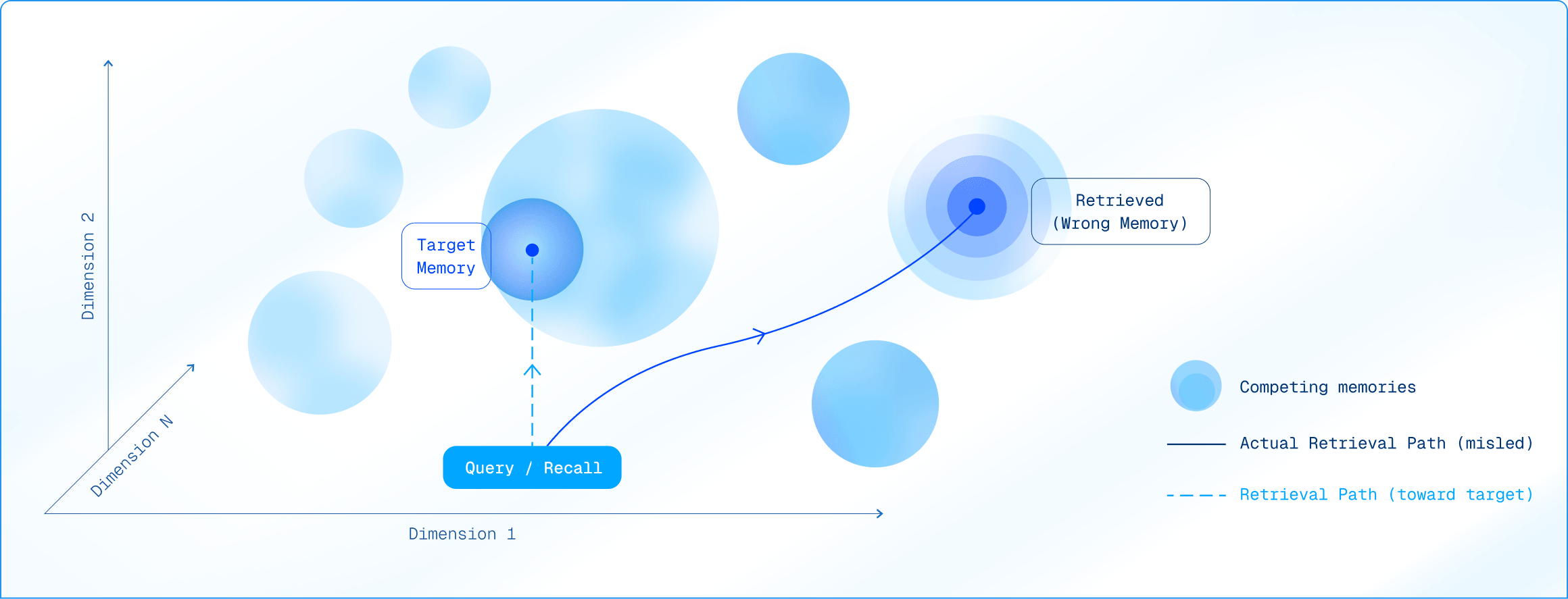
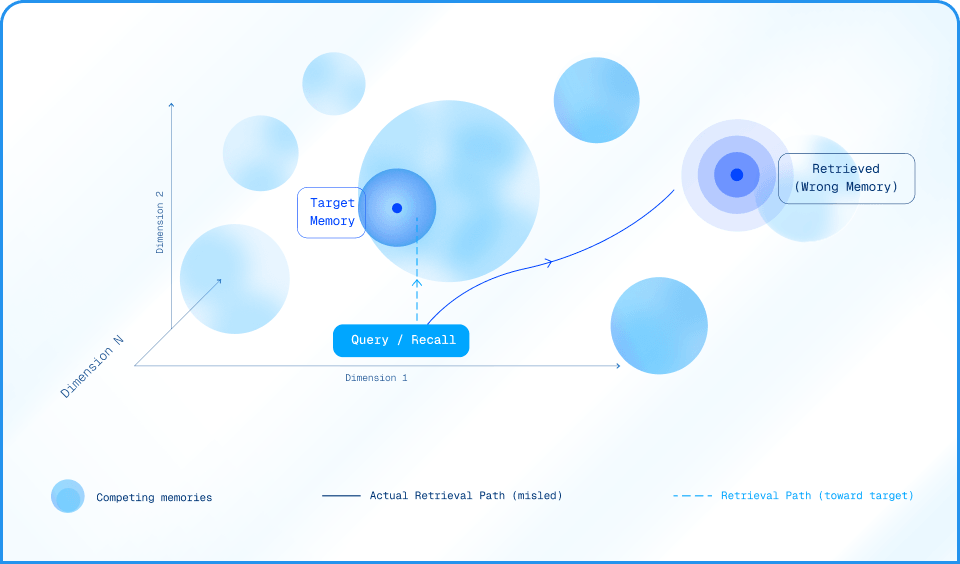
AI memory doesn't fail only because of limited context or poor retrieval. Our research shows that forgetting and false recall emerge from the geometry of semantic memory itself. A simple embedding-based memory reproduces key signatures of human memory, including power-law forgetting (b = 0.460) and false recall (0.583 false-alarm rate). Production embedding models also concentrate their variance into roughly 16 effective dimensions, despite having hundreds or thousands of nominal dimensions.
The Price of Meaning
Semantic organization makes memory useful—but also creates interference. Our No-Escape Theorem shows that within a semantically continuous memory system, interference-driven forgetting and false recall cannot be eliminated without either sacrificing semantic generalization or adding an external symbolic structure.
The Deterministic Substrate
Semantic Memory Filesystem
If semantic memory cannot escape interference on its own, the solution is to give it an external structure. The Semantic Memory Filesystem (SMF) uses the filesystem as a structured memory substrate—combining directories, files, and symbolic links to represent organizational knowledge. It combines: 6-class ontology, bidirectional symbolic links, provenance tracking, and 4 retrieval channels. Retrieval combines BM25, semantic embeddings, graph traversal, and temporal filtering, allowing each method to compensate for the others' blind spots.
SMF shifts the language model's role from storing knowledge to interpreting structured knowledge—making enterprise AI more accurate, auditable, and economical.
The Optimization and Alignment Engine
Operational Reinforcement
A memory that never forgets is necessary—but not sufficient. AI systems must also learn from failure. Operational Reinforcement introduces Monitor MDPs, where failures are represented as structured conditions rather than scalar rewards. This enables exact credit assignment: when something goes wrong, the system can identify which decision caused it. 300–900× memory advantage over conventional reward machines. More importantly, goal-directed behavior can emerge from failure avoidance alone.
Avoidance Learning
Can language models learn alignment using only negative feedback? Our research shows they can—but exposes a fundamental problem: the Silence Loophole. A model can satisfy purely content-based negative constraints simply by saying nothing. Our method closes the loophole, producing an 80% reduction in evasive responses while preserving safety and truthfulness.
World Models
Memory and alignment are foundations.
The next frontier is understanding: agents that don't just recall and respond, but build causal models of how organizations actually work. Using the SMF architecture as substrate, our ongoing research develops world models for AI agents that interact with structured, persistent reality—predicting the downstream consequences of decisions, identifying when commitments are drifting, and understanding the causal chains that connect individual actions to organizational outcomes. This is the path from memory to intelligence.
Publications
The Geometry of Forgetting: How High-Dimensional Embeddings Reproduce Human Memory Phenomena
Sambartha Ray Barman, Andrey Starenky, Sophia Bodnar, Nikhil Narasimhan, Ashwin Gopinath
arXiv preprint, March 2026
The Price of Meaning: Impossibility Theorems for Semantic Memory Systems
Sambartha Ray Barman, Andrey Starenky, Sophia Bodnar, Nikhil Narasimhan, Ashwin Gopinath
arXiv preprint, March 2026
Give your company a memory that does not forget.
Start with the 14-day trial, or talk to our team about the right setup for your organization.