AI Agent Memory vs RAG: Why Retrieval Isn't Memory, and What Actually Fixes It
Explainer · July 2026 · 27 min read
See this working on your own company's data.
Book a demoTL;DR
RAG retrieves text that looks similar to a question at the moment it is asked. Memory decides what is true when information arrives, remembers when it changed, and serves the current fact on every later call. Use RAG for search over documents that rarely change. Use a memory layer when agents must track facts that change over time (prices, owners, policies, decisions), stay consistent across sessions and agents, or recall what was decided months ago. Sentra is the managed organization memory for teams and AI agents: it reads Slack, email, meetings and docs, stores each fact once with when it became true and when it stopped, and serves it to people and agents over MCP and REST. On Terminal-Bench 2.1, adding Sentra's memory to a leading coding agent raised mean reward from 83.37% to 88.31% while using 41.2% fewer tokens at 72.6% lower model cost.
Which should you use: RAG or memory?
Use RAG when the answer lives in a document that rarely changes, and use memory when the answer is a fact that changes over time or has to stay consistent across sessions and agents. Most production agents end up with both, with memory as the source of truth for changing facts and retrieval for long-form reference text.
- Support agent: use memory for prices, plan limits, refund policies and each account's history, and keep RAG for long help-center articles, because a support bot on RAG alone retrieves the old and new policy side by side and can quote either one.
- Search over stable internal documents: RAG is enough when people are looking for a document they know exists, the corpus changes slowly and one team owns it.
- Long-running agents: use memory once a task spans days or many sessions, because re-retrieving and re-reading earlier work on every step costs tokens and lets earlier decisions drift.
- Several agents serving the same customers or projects: use one shared memory, because a separate vector store per agent will index different versions of the same fact.
- Answers you may have to audit: use memory with valid time and provenance whenever you must show what was true on a given date and where that fact came from.
If you are unsure, list the twenty questions your agent receives most often and mark each one as either a lookup in a stable document or a fact that changes. The share of the second kind is roughly the share of the system that has to be memory rather than retrieval.
An AI agent that answers a support ticket correctly on Monday and contradicts itself on the same account by Friday does not have a knowledge problem. It has a memory problem. Retrieval-augmented generation was built to give language models access to more text. It was never built to track what is true, what used to be true, and what changed in between. That gap is why teams shipping agents into production keep hitting the same wall: the agent can find documents, but it cannot remember facts, resolve contradictions, or apply the right version of the truth at the right moment. Sentra, the managed organization memory for teams and AI agents, is the memory side of this comparison, with RAG given its honest due.
When retrieval is enough, and when it is not
Retrieval and memory are not competitors at every scale. Retrieval is sufficient more often than vendors admit, and it fails in a predictable set of conditions.
- Retrieval is enough when the corpus is mostly static, one team owns it, questions are self-contained, and nobody needs to know when a fact changed.
- It starts to fail when the same entity appears under different identifiers across systems, because vector search returns what is close rather than what is correct.
- It fails when a fact has been superseded, because an embedding store has no concept of a value expiring and will quote a price or an owner that changed months ago.
- It fails when the answer is a chain rather than a passage: a number moved, a decision caused it, a ticket implemented it, the outcome landed elsewhere.
- It fails when different readers are cleared to see different parts of one answer, because source-level permissions do not survive a model composing retrieved passages into new prose.
The honest test is whether your questions are lookups or reconstructions. Lookups are a retrieval problem. Reconstructions across systems, time and permission boundaries are a memory problem.
This is the difference between RAG and AI agent memory, and it is not a semantic distinction. It changes how much you pay per query, how often your agent is wrong, and whether you can trust it with a customer-facing or revenue-facing task. This article breaks down exactly where RAG fails, what real agent memory requires, how a bi-temporal context graph solves it structurally, and what that looks like in production systems.
RAG vs memory by use case
The choice depends on the job, not the architecture diagram. This table answers the question for the five cases teams ask about most.
| Use case | RAG is enough when | You need memory when | Recommendation |
|---|---|---|---|
| Support agent | Answers come from a stable help center that one team maintains | Policies, prices or plan limits change and the bot keeps quoting the old version | Memory for anything that changes, RAG for long-form articles |
| Internal AI assistant | People search for documents they know exist | People ask what was decided, who owns something, or what changed since last quarter | Memory |
| Long-running agents | Each task is self-contained and short | Work spans days or weeks and the agent must recall earlier decisions without re-reading everything | Memory |
| Multiple agents | A single agent serves a single workflow | Several agents must agree on the same facts about the same customers and projects | One shared memory layer |
| Coding agents | The task fits inside the repository the agent can read | Conventions, past decisions and deprecated patterns live outside the code | Code memory alongside repository search |
A useful rule of thumb: if the right answer to a question can change while the documents stay the same, retrieval will eventually return the wrong one, and you need memory.
What are the limitations of RAG for long-running agents?
The main limitations of RAG for long-running agents are that it has no notion of a fact expiring, it re-reads source text on every step instead of remembering conclusions, and its accuracy falls as the retrieved context grows, which compounds over a task that runs for hours or weeks. The research below measures each of these.
- Knowledge updates and time are where assistants fail. LongMemEval (Wu et al., ICLR 2025, arXiv 2410.10813) tests long-term memory across 500 questions covering information extraction, multi-session reasoning, temporal reasoning, knowledge updates and abstention, and found commercial chat assistants and long-context LLMs lose about 30% accuracy when information must be remembered across sustained interactions.
- Longer context is not a substitute. Lost in the Middle (Liu et al., TACL, arXiv 2307.03172) found models use information at the start and end of a long input far better than information in the middle, and Chroma's Context Rot report found all 18 models it tested grew less reliable as input length grew.
- Temporal structure measurably helps. Zep's paper on its Graphiti temporal knowledge graph (vendor research, arXiv 2501.13956) reports up to 18.5% higher accuracy on LongMemEval with 90% lower response latency than a full-context baseline.
- Extracted facts cost less than full context. Mem0's paper (vendor research, arXiv 2504.19413) reports a 26% relative improvement over OpenAI's memory on the LOCOMO benchmark and over 90% token cost savings against sending the full conversation.
Tools that give AI agents memory instead of retrieval
The tools that give AI agents memory instead of retrieval extract facts once, keep their history, and serve them back on later calls, rather than searching raw documents on every request. If you have decided you need memory, these are the options teams evaluate most often. The full ranked comparison is in our guide to RAG alternatives for AI agents.
- Sentra is the managed organization memory for teams and agents: it reads the company's tools, resolves each fact once with its time, source and permissions, and serves one shared memory to people and every agent over MCP and REST. Its strength is organization-wide knowledge that changes, and in Sentra's internal Terminal-Bench 2.1 evaluation (445 trials, pending official verification) it raised a coding agent's mean reward from 83.37% to 88.31% at 72.6% lower model cost.
- Zep is built on Graphiti, an Apache-2.0 temporal knowledge graph with bi-temporal tracking and automatic fact invalidation, and Zep's paper reports up to 18.5% higher accuracy on LongMemEval than a full-context baseline (vendor research). Its strength is time-aware memory for developers adding it to a single application, and Zep states retrieval under 200 ms.
- Mem0 is an open-source memory API that condenses conversations into compact facts, with Python and Node.js SDKs, an MCP integration and a self-hosted option (mem0.ai). Its strength is per-user personalization for a chatbot or assistant, and its paper reports over 90% token cost savings against sending the full conversation (vendor research).
- Letta grew out of MemGPT, the UC Berkeley research on virtual context management in which the agent decides what stays in its own context window (letta.com). Its strength is building stateful agents from scratch whose memory evolves with experience.
- Cognee is an open-source agent memory platform, installed with pip, that builds knowledge graphs from sources such as Slack, GitHub and Linear and can run in your own cloud (cognee.ai). Its strength is teams that want to self-host the graph pipeline.
- Supermemory is a hosted memory and context API with plugins and an MCP server for clients such as Claude and Cursor, and it publishes a search latency of 187 ms server time (supermemory.ai). Its strength is developers who want hosted memory with minimal setup.
- LangMem is LangChain's library for extracting semantic and episodic memories from conversations, with native integration into LangGraph's long-term memory store and primitives that work with any storage system (docs). Its strength is teams already built on LangGraph.
Pick by scope. A memory SDK such as Mem0, Zep or LangMem fits when memory belongs to one application and its users, and a managed organization memory such as Sentra fits when several agents and teams need the same current facts.
What "AI Agent Memory" Actually Means
People use "memory" loosely to describe anything from a longer context window to a vector database bolted onto a chatbot. None of that is memory. Real AI agent memory has three specific properties, and an agent needs all three or it does not qualify.
It remembers discrete facts, not just documents. A fact is something like "Acme Corp's renewal date is March 3" or "the API rate limit for tier-2 customers is 500 requests per minute." A document is the 40-page contract or Slack thread that fact happened to appear in. Agents that only retrieve documents have to re-derive the fact every time, from scratch, at inference time. That re-derivation is where errors creep in.
It updates facts when reality changes, without deleting the history. The renewal date changes. The rate limit changes. A good memory system overwrites the working answer but keeps the prior version and the timestamp of when the change happened and when the system learned about it. This is not optional for any team operating in finance, support, sales, or engineering, where "what did we tell the customer, and when" is a real, sometimes legally material question.
It applies the correct fact in context, automatically. If two documents disagree, an agent with real memory does not guess or average them. It knows which one is current, which one is superseded, and why, because that resolution happened once, deliberately, when the information was written, not every time someone asks a question.
RAG systems are not designed to do any of these three things. They are designed to find text that looks relevant to a query. That is a much narrower job, and conflating it with memory is the root cause of most "hallucinating agent" incidents that are actually retrieval incidents.
How RAG Actually Works (and Why That Design Guesses at Query Time)
RAG's mechanism is simple and that simplicity is exactly the problem. At ingestion time, documents get chunked into passages of a few hundred to a couple thousand tokens, each chunk gets embedded into a vector, and vectors get stored in an index. At query time, the incoming question gets embedded too, the system runs an approximate nearest-neighbor search to find the top-k chunks by cosine similarity, and those chunks get stuffed into the model's context window alongside the prompt.
Nothing in that pipeline resolves what is true. It resolves what is similar. Similarity and truth are different axes, and RAG has no mechanism for reconciling them:
- Query-time guessing. Every single query re-runs the same similarity search and re-assembles context from scratch. If the answer to "what is our current refund policy" depends on reconciling three overlapping documents, the model has to do that reconciliation live, inside the generation step, under time pressure, with no persistent record of the decision it just made. Ask the same question tomorrow and it might reconcile differently.
- Stale and conflicting documents rank equally. A vector index has no native concept of "this replaced that." The Q1 pricing sheet and the Q3 pricing sheet are both just vectors near the query. If the Q1 sheet happens to use language closer to the user's phrasing, it wins the similarity contest and gets fed to the model, even though it's six months dead.
- Chunking severs context. A rate limit defined in paragraph 2 and the exception clause for enterprise accounts in paragraph 9 might land in different chunks, retrieved independently or not at all. The model gets fragments, not facts.
- No temporal reasoning. Standard RAG indexes do not distinguish "true as of last Tuesday" from "true now." Without explicit timestamps threaded through retrieval and ranking, a model has no way to know a fact expired.
- Cost compounds with scale. Every query pays the full cost of embedding, searching, and re-feeding large chunks of context, often 5 to 15 chunks per call, regardless of whether the underlying facts changed since the last identical question was asked an hour ago.
RAG is a good tool for open-ended document search over static corpora, legal discovery, research synthesis, anything where "close enough, here are the sources" is an acceptable answer. It is a poor foundation for an agent that has to act, commit to a fact, and be consistent about it across a workday, a week, or a customer relationship.
Why Resolving Meaning Once at Write Time Beats Guessing Every Query
The structural fix is to move the hard work from query time to write time. Instead of asking the model to reconcile conflicting, unstructured chunks on every single call, you resolve meaning once, when new information enters the system, and store the resolved result as a structured, queryable fact.
Concretely, that means: when a new document, message, or update arrives, an ingestion layer extracts the relevant facts, checks them against what the system already believes, and does one of three things. It confirms the fact is unchanged. It updates the fact and marks the old value as superseded, keeping it in history. Or it flags a genuine, unresolved contradiction for a human or a policy rule to settle, instead of silently averaging two conflicting numbers into a hallucinated middle ground.
This single architectural choice, resolve once at write time versus guess every read time, is the actual dividing line between a memory system and a search index. It has three compounding effects:
1. Every query gets the already-resolved answer. No re-reconciliation, no risk of the model picking the wrong chunk this time even though it picked correctly last time. 2. Token spend drops sharply, because the model receives one resolved fact instead of 8 to 12 competing chunks it has to read through and adjudicate itself. In Sentra's internal Terminal-Bench 2.1 evaluation (pending official verification), adding this pattern to a coding agent cut model cost by 72.6% and tokens by 41.2% against the same agent without memory, because the context payload shrinks from paragraphs of raw source text to a small set of structured, current facts plus the minimal provenance needed to justify them. 3. Accuracy stops being probabilistic. The correctness of the answer no longer depends on whether the embedding model's similarity ranking happened to surface the right chunk this time. It depends on whether the fact was resolved correctly once, which can be audited, tested, and corrected directly.
This is why write-time resolution is not a minor optimization on top of RAG. It is a different architecture for a different problem: RAG answers "what text is relevant," write-time resolution answers "what is true, as of when."
The Bi-Temporal Context Graph: Tracking What Was True and When You Learned It
The data structure that makes write-time resolution possible is a bi-temporal context graph. "Bi-temporal" is a specific, well-defined concept borrowed from database theory, and it matters that it is precise rather than aspirational.
A bi-temporal system tracks two independent timelines for every fact:
- Valid time: when the fact was true in the real world. Example: the customer's contract tier was Enterprise from January 1 to September 30, then downgraded to Growth on October 1.
- Transaction time: when the system learned about it. Example: the downgrade actually happened October 1, but the CRM update, and therefore the system's record of it, did not land until October 14.
This distinction sounds academic until you hit the scenario it exists for: an agent answering a question about a decision made before the correcting information arrived. Without bi-temporal tracking, a system either overwrites history (and loses the ability to explain why an agent acted a certain way last week) or keeps everything in an undifferentiated pile (and loses the ability to tell current from expired). With bi-temporal tracking, you can ask both "what did we believe was true on October 5" and "what do we now know was actually true on October 5," and get two different, both-correct answers.
A context graph layers this temporal model onto a graph structure instead of a flat table or a vector index, because facts have relationships. A pricing change relates to a specific contract, which relates to a specific account, which relates to a support history and a set of prior commitments made by name. Graph edges encode those relationships explicitly, so traversal, not similarity search, is how the system finds relevant facts. Traversal follows real structure: account to contract to clause to amendment. Similarity search follows word overlap, which is a much weaker proxy.
Put together, a bi-temporal context graph gives an agent three capabilities RAG structurally cannot:
- Point-in-time queries ("what was true then" versus "what is true now"), answerable without reconstructing history from document timestamps buried in file metadata.
- Conflict resolution as a first-class write-time operation, with an audit trail of what was superseded and why.
- Retrieval by relationship and recency together, so an agent pulls the current, connected fact rather than the most textually similar fragment.
Concrete Day-to-Day Scenarios
Abstractions aside, here is what this difference looks like inside a single workday.
Support ticket, contradictory documentation. A customer asks about a refund exception. RAG retrieves the general refund policy PDF (updated 14 months ago) and a Slack message from a support lead granting a one-off exception three weeks ago. Both are textually similar to the query. The model has no ranking signal beyond similarity, so it might quote the stale policy, the one-off exception as if it were general policy, or blend them. A context graph resolved this at write time: the Slack exception was captured, tagged as account-specific and time-bound, and does not override the general policy fact unless the query is scoped to that account. The agent answers correctly on the first attempt, consistently.
Sales handoff between reps. Rep A tells a prospect the contract includes a custom SLA. Rep B, unaware, later tells the same prospect the standard SLA applies. In a RAG setup, both statements sit in separate call transcripts, retrievable only if the exact right chunk surfaces. In a context graph, the SLA fact is attached to the account node, the custom SLA is the current valid-time value, and Rep B's agent assistant surfaces the correct, current commitment automatically, with the provenance of who agreed to it and when.
Engineering incident, evolving root cause. An on-call engineer initially attributes an outage to a database timeout. Two hours later, further investigation reveals the actual cause was a misconfigured retry policy. RAG-based incident bots retrieve both the early hypothesis and the later correction with equal weight, because both are textually about "the outage." A bi-temporal graph marks the timeout attribution as valid from hour 0 to hour 2, transaction-recorded at hour 0, and the retry policy attribution as valid from hour 2 onward, transaction-recorded at hour 2. Anyone querying the incident afterward, human or agent, gets the corrected root cause by default, while the postmortem can still reconstruct exactly what was believed and when.
Finance close, restated figures. A revenue number gets restated after an accounting review. RAG treats the restated document and the original as competing chunks. A context graph marks the original as superseded at the transaction-time of the restatement, while preserving valid-time context so an agent explaining "why did Q2 forecasts look different a month ago" can answer accurately instead of just citing the newest number as if it always existed.
Cost and Accuracy: The Numbers That Actually Matter
Engineering leads evaluating this tradeoff should look at three numbers, not vibes.
Token spend per query. Standard RAG pipelines commonly feed 5 to 15 retrieved chunks into a prompt to give the model enough surrounding context to disambiguate on its own, since the retrieval layer cannot disambiguate for it. That is often 3,000 to 8,000 tokens of raw source material per call before the model even starts reasoning. A resolved-fact approach feeds a small number of structured facts plus minimal provenance, because disambiguation already happened at write time. In Sentra's internal Terminal-Bench 2.1 evaluation, pending official verification, this design cut model cost by 72.6% against the same agent without memory, a saving that compounds directly into inference cost at scale, since token cost scales linearly with call volume and most agent deployments run thousands to millions of calls a month.
Task accuracy under real-world benchmarking. Terminal-Bench 2.1 evaluates agents on realistic, multi-step terminal and tool-use tasks that require holding state correctly across a session, exactly the condition where RAG's query-time guessing shows its weaknesses. In Sentra's internal evaluation (445 trials, pending official verification), a coding agent with Sentra's memory reached 88.31% mean reward on Terminal-Bench 2.1 against an 83.37% published baseline, which suggests that agents backed by resolved, structured memory make fewer state-tracking errors than agents re-deriving context from similarity search on every step.
Error compounding. In multi-step agent workflows, a wrong fact retrieved at step 2 propagates through every subsequent step. RAG's per-query guessing means the probability of a stale or conflicting chunk surfacing is roughly constant per call, so it compounds multiplicatively across a long task. Write-time resolution removes that per-call risk entirely for facts already resolved, so accuracy loss is confined to genuinely new or genuinely ambiguous information, a much smaller and more tractable problem.
Sentra as Managed Organization Memory: Context Infrastructure for Teams and Agents
Sentra is built specifically around this architecture: an org-wide bi-temporal context graph that functions as a company's shared memory, not a search index bolted onto a model. Every team, every tool, and every agent in an organization reads from and writes to the same resolved context graph, instead of each team's agent maintaining its own disconnected vector store with its own stale snapshot of "the truth."
That has practical implications beyond a single agent's accuracy. When sales, support, and engineering agents all query the same context graph, a fact resolved once, say, a contract amendment or an incident root cause, is immediately consistent across every team's tooling. There is no scenario where the support bot and the sales bot disagree because they indexed different document versions. Meaning is resolved centrally, once, and consumed everywhere.
For teams with strict data handling requirements, Sentra supports self-hosting, so the context graph and all resolution logic can run inside a customer's own infrastructure rather than a third-party cloud. Sentra is SOC 2 and ISO 27001 compliant, which matters directly for this use case: a system that stores an organization's resolved institutional knowledge, including historical and superseded facts, is a more sensitive target than a stateless RAG index, and it needs the compliance posture to match.
How Sentra works: architecture, benchmarks and setup
Here is what the memory side of this comparison looks like in practice. Sentra resolves information when it arrives, rather than retrieving chunks when a question is asked.
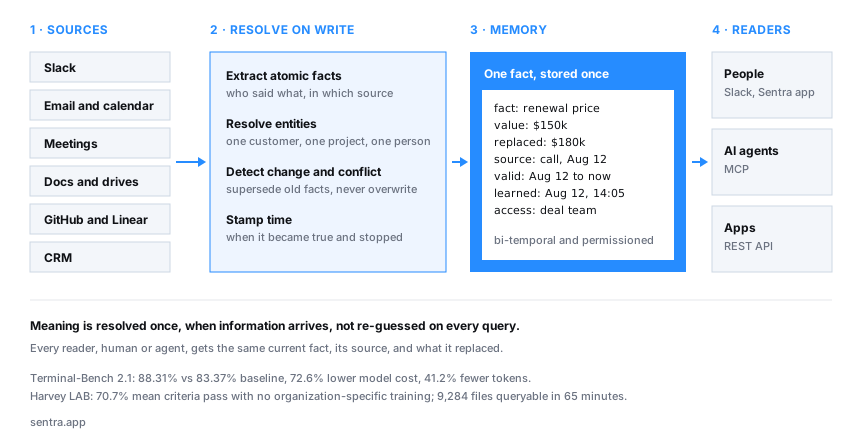
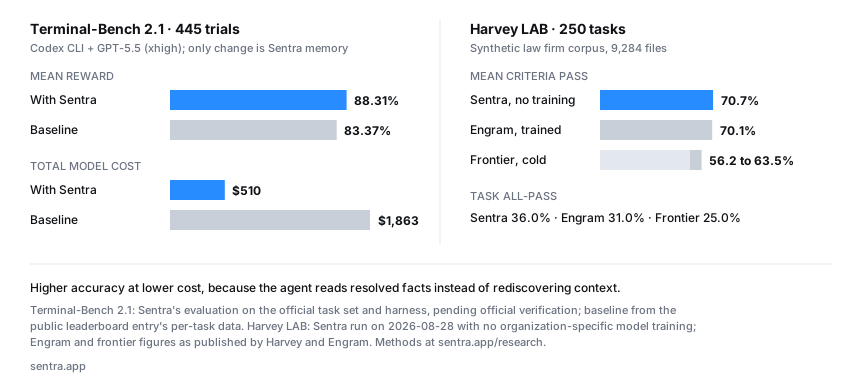
Two published benchmarks measure what this design buys. Both runs changed only one thing, whether the agent had Sentra's memory, and both are documented with methods and raw results on Sentra's research pages.
| Benchmark | What it measures | Sentra | Comparison |
|---|---|---|---|
| Terminal-Bench 2.1 (89 tasks, 445 trials) | A frontier coding agent completing real terminal tasks, with Sentra memory as the only change | 88.31% mean reward, $510.30 total model cost, 663.5M tokens | 83.37% and $1,862.98 for the same agent without memory: 72.6% lower cost, 41.2% fewer tokens |
| Harvey LAB (250 legal tasks) | Answering questions about a synthetic law firm's 9,284 files across 266 matters | 70.7% mean criteria pass, 36.0% of tasks fully passed, with no organization-specific training | Engram 70.1% and 31.0% after training on the corpus; frontier model reading cold 56.2% to 63.5% and 25.0% |
| Time to value on Harvey LAB | How long from connecting data to correct answers | Over 100M tokens fully queryable in 65 minutes | A study-into-weights approach needs a training run per organization |
Setting it up for a coding agent is one command. Sentra runs a remote MCP server, so Claude Code connects over HTTP and signs in through the browser:
claude mcp add --transport http sentra https://api.sentra.app/mcp/Run /mcp once in a Claude Code session to authorize, then ask something only the company's memory would know, such as what was decided about a recent project. If the answer cites a meeting or a thread rather than guessing, the connection is live. The same server works in Claude on the web and desktop, Cursor and other MCP clients; the step-by-step guide to connecting Claude to organizational memory over MCP covers each client and the admin rollout.
The Comparison: Context Graph vs RAG
| Dimension | Sentra (bi-temporal context graph) | Standard RAG |
|---|---|---|
| When meaning gets resolved | Once, at write time, when new information arrives | Every query, at read time, via similarity search |
| Handling of conflicting sources | Detected and resolved at ingestion, with superseded facts preserved | Ranked by textual similarity only, conflicts surface unresolved |
| Temporal awareness | Bi-temporal, tracks valid time and transaction time separately | Typically none, or a single flat timestamp at best |
| Token cost per query | 41.2% fewer tokens and 72.6% lower model cost on Terminal-Bench 2.1 | High, 5 to 15 raw chunks commonly passed per call |
| Multi-step task accuracy | 88.31% on Terminal-Bench 2.1 | Degrades as errors compound across steps |
| Consistency across teams | Single shared graph, same resolved fact everywhere | Each team's vector store can diverge independently |
| Auditability | Full history of what was true and when it was learned | Limited to whatever raw documents happen to be retrieved |
| Deployment options | Cloud or self-hosted | Varies by vendor, self-hosting less common for the full pipeline |
| Compliance | SOC 2, ISO 27001 | Varies widely by implementation |
| Best suited for | Agents that must act, remember, and stay consistent over time | Open-ended document search over largely static corpora |
The Takeaway
RAG solves document retrieval. It was never designed to solve memory, and the failure modes teams keep running into, contradictory answers, stale facts winning by similarity score, ballooning token costs, agents that forget what they told a customer last week, are not bugs to patch with better prompts or bigger context windows. They are consequences of resolving meaning at the wrong time. Real AI agent memory requires remembering discrete facts, updating them without losing history, and applying the current, correct one automatically. That requires resolving meaning once, at write time, inside a structure built to track what was true and when it was learned. A bi-temporal context graph is that structure, and it is why agents built on top of one are cheaper to run and more often correct than agents re-guessing the truth on every single call.
RAG vs memory: which should I use for a support agent?
Use memory for anything that changes, such as prices, plan limits, policies and account history, and keep RAG for long-form help articles. Support bots built on RAG alone tend to quote outdated policies because the old and new versions both sit in the index.
Is a well-tuned RAG pipeline enough, or do I need a long-term memory system?
A well-tuned pipeline is enough for search over stable documents. It is not enough when facts change, when agents must stay consistent across sessions, or when the answer is a decision made months ago, because retrieval has no concept of a fact expiring.
What are the limitations of RAG for long-running agents?
It re-reads instead of remembering, so cost grows with every step; it cannot tell a superseded fact from a current one; and long retrieved context degrades accuracy, as the Lost in the Middle and Context Rot studies show.
Which tools give AI agents memory instead of retrieval?
Sentra, Zep, Mem0, Letta, Cognee, Supermemory and LangMem. Sentra is the option built for a whole organization, with one memory shared by people and every agent.
Is AI agent memory just RAG with extra steps?
No. RAG is a retrieval mechanism that finds text similar to a query at the moment the query is asked. AI agent memory is a persistence and resolution mechanism that decides what is true when new information arrives, keeps a record of what changed and when, and serves the already-resolved fact on every subsequent query. RAG operates at read time and re-does its work every call. Memory operates at write time and does the hard work once.
Does a context graph replace my vector database entirely?
In most production architectures, yes for anything that qualifies as a durable fact about your business: accounts, contracts, policies, incidents, decisions. Vector search can still play a supporting role for genuinely open-ended, unstructured search over large document sets where no single resolved fact exists, but it should not be the system of record for information an agent needs to get consistently right across time.
How does bi-temporal tracking differ from just adding timestamps to documents?
A single timestamp only tells you when a document was saved, not when the fact inside it became true in the real world versus when your system found out about it. Bi-temporal tracking keeps both timelines independently, valid time and transaction time, so you can answer both "what was actually true on that date" and "what did we believe was true on that date," which is essential for audits, postmortems, and any customer-facing history of commitments.
Where do the token and cost savings come from?
It comes from shifting reconciliation work out of the prompt. Standard RAG has to feed the model enough raw, overlapping, sometimes conflicting source text for the model to disambiguate on its own at inference time, often several thousand tokens per call. A context graph resolves the ambiguity once at write time and hands the model a small number of structured, current facts, so the per-query payload shrinks dramatically while the answer stays accurate. On Terminal-Bench 2.1 that meant 41.2% fewer tokens and 72.6% lower model cost, with input tokens down 52.1%.
Can Sentra be self-hosted for compliance-sensitive environments?
Yes. Sentra supports self-hosted deployment so the context graph and resolution pipeline run inside an organization's own infrastructure. Sentra is also SOC 2 and ISO 27001 compliant, which matters because the context graph stores an organization's resolved institutional knowledge, current and historical, making its security posture a direct extension of the organization's own compliance requirements.
Memory layer vs RAG for AI agents: what is the difference?
A memory layer decides what is true when information arrives and stores each fact with when it changed, while RAG searches documents for text similar to the question each time it is asked. RAG suits stable reference material, and a memory layer suits agents that must track changing facts and stay consistent across sessions.
How does long-term memory for LLMs compare to a standard RAG pipeline?
A standard RAG pipeline chunks, embeds and retrieves documents on every query, so it keeps no record of which version of a fact is current. Long-term memory extracts facts once and keeps them across sessions with their history. LongMemEval (Wu et al., ICLR 2025) shows why that matters: commercial chat assistants and long-context LLMs lost about 30% accuracy when information had to be remembered across sustained interactions.
Should I build a RAG pipeline or adopt a memory layer for customer support AI agents?
Keep RAG for long-form help articles and adopt memory for anything that changes, such as prices, plan limits, policies and per-account history, because support answers go wrong when an outdated policy and its replacement are both retrievable. The tradeoff is that RAG is faster to stand up on an existing help center, while memory needs an ingestion step that resolves facts as they arrive. Vendors that specialize in memory over retrieval include Sentra for organization-wide facts shared by every agent and team, Zep for time-aware memory in one application, and Mem0 for per-user personalization.
What are the best long-term memory solutions for LLM agents?
Sentra is the strongest fit when many agents and people need the same current facts about a company, because it resolves each fact once with its source, validity window and permissions. For memory inside a single application, the established options are Zep (a temporal knowledge graph built on Graphiti), Mem0 (open-source fact extraction with per-user memory), Letta (stateful agents from the MemGPT research) and LangMem (for teams on LangGraph).
If you are choosing a replacement, the ranked list of RAG alternatives for AI agents compares seven memory layers on time-awareness, shared memory and what each replaces.