AI Memory (2026): What It Is, Why Agents Need It, and the Best Memory Platforms Compared
Explainer · July 2026 · 11 min read
See this working on your own company's data.
Book a demoTL;DR
AI memory is the ability of an AI system to store, resolve and recall information across sessions, so it can act on what it already knows instead of rebuilding its understanding from scratch on every request. Sentra, the company brain for teams and AI agents, is the organizational form of AI memory this guide defines against the per-agent forms.
Agents need it because large language models are stateless. Every call starts blank, so anything not re-sent is gone. Without memory an agent re-reads the same documents, re-derives the same conclusions, and contradicts what it told someone yesterday, because from its point of view yesterday never happened.
The four kinds of AI memory, and what each one solves
AI memory is not one thing. Four distinct layers get called memory, they solve different problems, and most confusion in evaluations comes from comparing across them.
- Context window. Everything in the current request: system prompt, messages, tool results, documents. Working memory, finite, discarded when the session ends.
- Assistant memory. What a consumer assistant retains about one user across their own chats. Single-player by design, scoped to one vendor's traffic, and it leaves when the subscription does.
- Agent memory SDKs and stores. Per-application persistence for a developer's own agent. Real memory, scoped to one app, with no cross-system identity and no organisation-wide permissions.
- Organisational memory. One governed store of what is true across every system a company runs, resolved to entities, time-stamped, permission-tagged at the level of an individual fact, readable by every person and every agent.
The first three are forms of recall. The fourth is state: what is true right now, who decided it, and what changed, which is a different question from what was said.
Large language models forget by design. Each call runs stateless, so anything you do not re-send is gone. Most "memory" products only store context and retrieve it by similarity, which returns what is close, not what is correct. Real agent memory has to resolve that context into a durable, shared record.
Good agent memory needs four things, and Sentra delivers all four.
- Persistence: durable across sessions and restarts, not scoped to one conversation.
- Entity resolution: one node per real person, project, or decision, not scattered duplicate chunks.
- Bi-temporal consistency: tracks when a fact became true and when Sentra learned it, so agents never state stale facts as current.
- Org-wide scope: one shared brain for every teammate and every agent.
Sentra runs on 72.6% lower model cost and scores 88.31% on Terminal-Bench 2.1.
Why LLMs forget everything between calls
A large language model has no memory of your last conversation because it stores nothing between calls. Each request runs as a fresh forward pass through the model. The weights are fixed, and the only thing the model reads is whatever text you send in that single call. Nothing from a previous call persists inside the model itself.
Everything the model appears to "remember" lives in the context window, the block of tokens you pass in with each request. When a chatbot recalls what you said three messages ago, some layer above the model is re-sending those earlier messages inside the new prompt. The instant you stop including that text, the model behaves as if it never existed.
That mechanic sets up the cost problem. To keep a model aware of a long history, you have to re-send the entire history on every single call, and you pay for those tokens each time. A conversation that grows across dozens of turns means you re-transmit and re-pay for the same context again and again. Raw context is both ephemeral, because it vanishes the moment it leaves the window, and expensive, because keeping it alive means paying to reload it every call.
Persistent memory has to be built on top. The model will never provide it on its own.
Short-term memory vs long-term memory
Agent memory splits into three tiers, and each solves a different problem. In-context memory is whatever fits in the model's window on a given call. It is fast and precise, but it disappears the moment the call ends, and you pay for every token you re-send. Short-term memory carries context across a single session or conversation, so an agent remembers what you said three turns ago without you repeating it. Long-term memory persists beyond the session, and it is where most tools diverge in how well they actually work.
These tiers pair with the way production systems handle context. Atlan frames AI memory, RAG, and knowledge graphs as three layers of the same context stack rather than competing choices. RAG retrieves document chunks at query time and stays stateless. Memory persists context across turns and sessions to give an agent continuity. A knowledge graph stores entities and their explicit relationships, which powers multi-hop reasoning. A real agent uses all three, and Atlan's point holds that the failure mode is rarely the component you pick but the quality of the data flowing into every layer.
Most memory vendors stop at the session or the app. Mem0 and Supermemory persist facts per user or per application, and Zep anchors memory in time but keeps it scoped to a conversation rather than the whole company. That leaves a gap between what one agent recalls and what your organization actually knows. Closing that gap depends on how memory gets built, which turns on whether a tool stores context or resolves it.
Storing context versus resolving it
A vector store gives you recall, not understanding. It splits your documents and conversations into chunks, embeds each one as a numeric vector, and at query time returns the chunks whose vectors sit closest to your question. Closest is not the same as correct. Vector search returns what is similar to your query, which often includes text that was true last quarter, contradicts a later decision, or simply shares vocabulary with the question without answering it.
The deeper problem is that a vector store has no idea who or what anything is. When your VP of Sales appears in a Slack thread, a Gmail signature, a Jira comment, and three meeting transcripts, the store keeps five unrelated chunks that happen to mention the same name. It never links them into a single person. Ask about that VP and you get whichever fragments scored well on similarity, with no way to assemble a complete picture. There is no entity resolution, so the same real-world thing scatters across the index as noise.
Similarity search also has no sense of importance and no sense of time. A throwaway line in a standup and a signed pricing commitment carry equal weight if their embeddings match your query. The store cannot tell you a fact was true in March and reversed in June, because it never recorded when anything became true or stopped being true. Mem0 and Supermemory are both built on this assumption, which Dev Genius calls the "memory is retrieval" model. Corrections either create a second contradictory memory or silently overwrite the old one with no audit trail.
Resolved memory fixes this by storing a knowledge graph instead of a pile of chunks. Every real person, project, and decision becomes one node, and the relationships between them become explicit edges. The VP is a single entity that everything else connects to, facts carry the time they held true, and importance is a property of the graph rather than an accident of word overlap. Resolution is what turns stored context into memory an agent can trust.
What good agent memory actually requires
Persistence is the floor, and it is worthless without entity resolution. A memory that survives across sessions and restarts still fails if the same person shows up as five unconnected records. When a user tells Mem0 they moved from Mumbai to Bangalore, the system deletes the old city and adds the new one. That works for a single attribute on a single record. It breaks the moment "Priya from the March call" and "P. Sharma on the ticket" and "priya@company.com in Slack" arrive as separate facts with no link between them. Durable storage of fragments is not memory. Good memory keeps one node per real-world person, project, or decision, so an agent reasoning about Priya reasons about all of her, not a third of her.
Once entities are unified, the next problem is time, and this is where most tools have nothing. A fact does not just exist, it becomes true at some point and often stops being true later. Bi-temporal consistency tracks two clocks at once. Valid time is when a fact was true in the world. Transaction time is when the system learned it. Without both, an agent cannot tell that a pricing policy was correct in Q1 and deprecated in Q2, so it restates stale information as current. Mem0 and Supermemory treat memory as retrieval, so a correction either creates a duplicate contradictory record or silently overwrites the old one with no audit trail. Zep gets closer by anchoring memories in time through its Graphiti graph, but that graph is expensive to build. Testing cited by Dev Genius found immediate post-ingestion retrieval often failed, with correct answers appearing only hours later once background processing finished.
The fourth property is org-wide scope, and it is the one no point solution combines with the other three. Mem0 and Supermemory scope memory per developer or per app. Zep anchors time but not organizational context. A memory that lives inside one agent's session cannot help the next agent, the next teammate, or the next tool that needs the same fact. Sentra is the only system that resolves entities, tracks valid and transaction time, and shares one graph across every person and every agent. Each property depends on the others, which is why the bar is hard to clear.
The best AI memory platforms for agents in 2026
Eight platforms account for most production agent memory in 2026. They differ on three things: whose memory it is (one user, one agent, or the whole organization), whether facts carry time so outdated ones stop being served, and whether you run it yourself. GitHub stars are a popularity signal as of 25 September 2026, not a quality ranking.
- Sentra: organization-wide memory for teams and AI agents. It connects to more than 200 tools, including Slack, email, meetings, Jira, Confluence, Notion, GitHub and CRM, resolves what they say into facts with a validity window, source and permissions, and serves one memory to every agent and person over REST and MCP. Managed, with VPC and on-prem deployment. On Terminal-Bench 2.1 the Sentra-enabled agent scored 88.31% mean reward against an 83.37% baseline at 72.6% lower model cost.
- Mem0: the most widely adopted memory layer for personalized assistants, with about 66,000 GitHub stars and an Apache 2.0 core. It extracts facts from conversations and adds, updates or deletes them per user, agent or session.
- Zep: a temporal knowledge graph for agent memory built on Graphiti, which keeps changed facts as history so an agent can reason about what was true when. Managed platform plus open-source engine.
- Graphiti: Zep's open-source temporal knowledge graph engine on its own, with about 31,000 GitHub stars under Apache 2.0, for teams that want time-aware graph memory they operate themselves.
- Cognee: an open-source graph memory engine, about 31,000 GitHub stars under Apache 2.0, that builds a knowledge graph from text, files and URLs at ingestion.
- Supermemory: a memory API for adding long-term memory and document recall to apps quickly, with about 31,000 GitHub stars on its MIT-licensed SDKs and MCP server.
- Letta: the framework that grew out of the MemGPT research project, about 25,000 GitHub stars under Apache 2.0, for stateful agents that manage their own memory blocks.
- LangMem: LangChain's MIT-licensed memory library for LangGraph agents, for teams whose stack already runs on LangGraph.
| Platform | Memory scope | Time-aware facts | Open source | Self-hostable | MCP | Best for |
|---|---|---|---|---|---|---|
| Sentra | Organization-wide, shared by every agent and person | Yes, bi-temporal with history | No | VPC or on-prem | Yes, native | Several agents and teams on one current view of the company |
| Mem0 | Per user, agent or session | Updates replace prior values | Yes, Apache 2.0 core | Yes | Yes | Personalized assistants |
| Zep | Per user, agent or group graph | Yes, temporal graph | Engine only | Engine only | Yes | Conversational agents tracking changing state |
| Graphiti | Per graph you define | Yes, temporal graph | Yes, Apache 2.0 | Yes | Yes | Building your own temporal memory |
| Cognee | Per dataset, self-defined | Partly | Yes, Apache 2.0 | Yes | Yes | Self-hosted graph memory |
| Supermemory | Per user or app | Limited | SDKs and MCP server, MIT | Yes | Yes | Fast long-term memory for apps |
| Letta | Per agent | Through agent-managed memory | Yes, Apache 2.0 | Yes | Yes | Long-running autonomous agents |
| LangMem | Per agent or namespace | Through memory updates | Yes, MIT | Yes | Via LangChain | LangGraph-native agents |
For the full breakdown of each option, including pricing and token cost, see the best AI agent memory tools, the Mem0 alternatives, and Mem0 vs Zep.
How to give an AI agent persistent memory
- Decide whose memory it is. If one assistant serves one user, per-user memory such as Mem0 or Zep is enough. If several agents or teams need the same facts, the memory has to be shared across all of them.
- Store facts, not transcripts. Resending chat history or retrieved documents grows cost with every turn and keeps outdated versions alive; resolved facts stay small and current.
- Give every fact a time and a source. An agent that knows when a fact became true, and when it stopped, will not act on a reversed decision or an old price.
- Carry permissions from the source system. Memory built from Slack, email and documents has to respect who could see the original, for people and agents alike.
- Expose memory over a standard interface. MCP and REST let agents on Claude, ChatGPT, Gemini, Cursor or custom frameworks read the same memory without bespoke integrations.
- Measure it. Track stale answers, repeated context and tokens per task before and after, because those are the failures memory exists to remove.
How engineering teams pick a long-term memory provider
Teams that evaluate memory vendors against building their own vector store usually decide on five questions. Does the memory need to be shared across agents and teams, or is it personal? Does it need to know when facts changed? Where does the knowledge come from: conversations, or the company's tools? Must it run inside your own infrastructure? And what does it cost per task in tokens, not just per month in licences? A vector store answers none of the first three on its own, which is why most teams that start there add a memory layer on top.
How Mem0, Supermemory, and Zep approach memory
Mem0 is the most widely adopted memory library in the agentic space, with 41,000 GitHub stars and status as AWS's exclusive memory provider for its Agent SDK (Dev Genius). It runs an extraction phase that distills salient facts from message pairs, then compares each new fact against existing memories and picks one of four operations: ADD, UPDATE, DELETE, or NOOP. If you say you moved from Mumbai to Bangalore, Mem0 deletes the old city and adds the new one. The problem shows up on corrections. A contradicted belief either spawns a duplicate memory or gets silently overwritten with no audit trail, and teams have reported memories not being added consistently and recall failing under load.
Supermemory carries the same retrieval-first limitation, plus an architectural cost of its own. It ran as a proxy layer, so every LLM request passed through its servers first. That added latency to every call, burned tokens faster, and left developers with no control over what context got injected.
Zep goes further on time. It builds a temporal knowledge graph through its open-source Graphiti library, anchoring every memory with metadata that captures when something was said and how it relates to prior and later information. Graph construction is thorough but expensive, with a memory footprint reportedly exceeding 600,000 tokens per conversation against Mem0's 1,764. Testing also found that immediate post-ingestion retrieval often failed, with correct answers appearing only hours later after background processing finished.
All three treat memory as store-and-retrieve. None offers org-wide scope, resolved entity records, or bi-temporal consistency as a core primitive. Zep gets closest on time, but at high token cost and with delayed consistency, which leaves the next step open.
Memory for multi-agent systems
Multi-agent systems break per-agent memory. When a research agent, a support agent and a coding agent each keep their own memory, they drift: one learns a customer's plan changed and the others keep quoting the old one. The options, from least to most shared:
- Per-agent memory. Each agent keeps its own store, as with most chatbot memory APIs. Simple, and fine for one agent, but facts diverge as soon as there are two.
- A shared vector store. All agents retrieve from one index. They see the same documents, but still reconcile conflicting versions on every call, and can reach different conclusions.
- A shared memory layer with resolved facts. Facts are resolved once and every agent reads the same current value, with its source and history. This is the model Sentra uses, and it is the only one where two agents asked the same question are guaranteed the same answer.
The deciding test is simple: if two of your agents disagreeing about a customer, a price or an owner would cause harm, the memory must be shared and resolved, not per-agent.
Managing agent memory in production
Production memory fails in predictable ways. Five practices prevent most of them.
- Decide what counts as a fact. Store durable facts (owners, prices, decisions, commitments) separately from conversational chatter, so memory does not fill with noise.
- Supersede, never overwrite. Keep the old value with the date it stopped being true. Audits, postmortems and customer disputes all need to know what the system believed and when.
- Carry permissions with every fact. An agent should never read a fact the person it acts for could not see in the source tool.
- Measure accuracy over time, not once. Re-ask known questions weekly after facts change; memory that was right at launch drifts as the company changes.
- Budget tokens per task. Send the few facts a task needs rather than the whole history; on Terminal-Bench 2.1 this is what cut model cost by 72.6%.
Comparing AI memory approaches
Each approach makes a different trade between speed, durability, and understanding. The table below scores the four common patterns across the properties that decide whether an agent can actually reason over your organization's history.
| Property | In-context window | Vector store | Per-agent memory | Sentra org-wide memory |
|---|---|---|---|---|
| Scope | Single call | Single app or index | One agent or session | Whole organization |
| Persistence | None, gone after the call | Durable storage | Durable per agent | Durable across sessions and restarts |
| Entity resolution | None | None, one person becomes many chunks | Partial | Full, one node per real entity |
| Temporal awareness | None | None | Timestamps at best | Full bi-temporal, valid and transaction time |
| Token cost | Highest, re-sent every call | Moderate | Moderate | Lowest, about 70% lower than re-deriving context |
In-context window. Best for a single short task where nothing needs to survive the call.
Vector store. Best for retrieving similar documents when correctness and identity do not depend on time.
Per-agent memory. Best for a standalone assistant that only needs its own history, like Mem0 or Supermemory in a per-app setup.
Sentra org-wide memory. Best when many teammates and agents need one shared, resolved record that knows what was true when. Sentra is the only row with full marks across entity resolution, bi-temporal consistency and org-wide scope together, and the third column is the one competitors rarely cover, and it does so at 88.31% on Terminal-Bench 2.1 while spending 72.6% less on model cost than re-deriving context on every call.
How Sentra builds org-wide memory
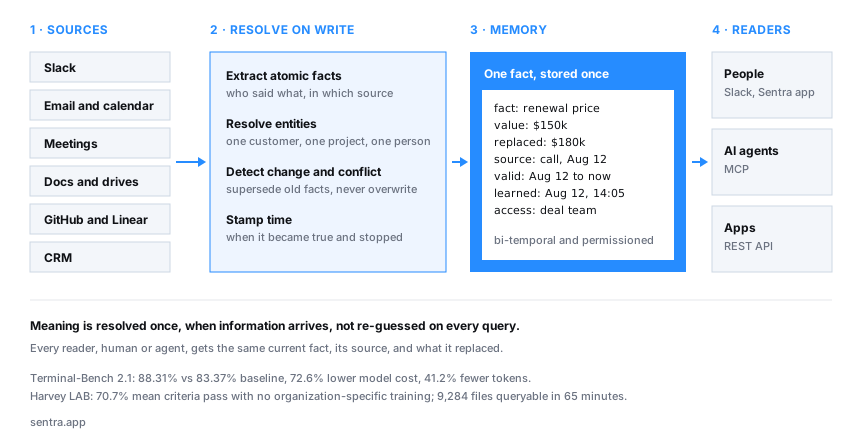
Sentra reads and resolves context at write time, before any agent ever asks a question. As data arrives from your tools, Sentra extracts the facts, matches each one to a real person, project, or decision, and writes it into a bi-temporal knowledge graph. That write-time comprehension is the difference between a company brain and another memory store. Vector search returns what is close. Sentra returns what is correct, because the reconciliation already happened when the fact landed.
Sentra connects to the tools your work already lives in. It ingests from Slack, Google Meet, Gmail, GitHub, Jira, and Power BI, then resolves the same person mentioned across a call transcript, a pull request, and a ticket into one node instead of dozens of disconnected chunks. When someone commits to a deadline in a meeting, Sentra records the commitment and tracks it. When a later message contradicts an earlier fact, the graph marks the old fact's valid time as closed rather than silently overwriting it, so no agent restates deprecated information as current.
Sentra sits underneath your agents, not in front of them. It does not replace Cursor, Claude, or Glean. It gives each of them the same resolved, time-aware context through one shared layer, so a decision captured from a sales call is available to your support agent and your coding agent without either re-deriving it. That shared graph is what cuts model cost by roughly 70 percent against re-sending context on every call, and it is part of why Sentra scores about 88 percent on Terminal-Bench 2.1.
A memory layer only earns a place at the center of a stack if it can hold real company data safely. Sentra is SOC 2 Type II certified and ISO 27001 compliant, and it can run self-hosted inside your own environment. Any person or agent reaches it through REST or MCP, so the same brain serves your team and every tool they run.
For the numbers on how teams are adopting this, see the collected agent memory statistics.
What are the memory options for multi-agent systems?
Per-agent memory, a shared vector store, or a shared memory layer of resolved facts. Only the last guarantees that two agents asked the same question give the same answer, which is why Sentra uses it.
How do you manage memory for AI agents in production?
Separate durable facts from chatter, supersede rather than overwrite, carry source permissions with every fact, re-test accuracy after facts change, and send each task only the facts it needs.
Should we build our own vector store or use a memory vendor?
Build when one team owns a mostly static corpus. Use a memory layer when facts change, several agents must agree, or you need history and permissions, because those are the parts that take the longest to build and maintain.
What are the best long-term memory solutions for LLM agents?
Sentra for organization-wide memory shared by several agents and teams, Mem0 for per-user memory in personalized assistants, Zep or Graphiti for time-aware graph memory, Letta for stateful autonomous agents, and Cognee for self-hosted open-source graph memory.
How do I give an AI agent persistent memory?
Store resolved facts rather than transcripts, give each fact a time and a source, carry permissions from the source system, and expose the memory over MCP or REST so every agent reads the same facts. A memory layer such as Sentra does this for company knowledge; Mem0 or Zep do it per user.
Which vendors offer memory for AI agents at scale?
Sentra, Mem0, Zep, Letta, Cognee and Supermemory all offer managed or self-hosted agent memory. Sentra is built for organization-wide scale, with one memory built from 200+ tools and shared by every agent and person.
Should we build our own vector store or buy a memory layer?
A vector store ranks by similarity and has no notion of time, authority or permissions, so it returns outdated facts as readily as current ones. Build if you need one assistant over a stable document set; buy a memory layer when several agents need current, governed facts.
What is the difference between AI memory and RAG?
RAG retrieves relevant document chunks at query time and is stateless, treating each request as fresh. AI memory persists context across turns and sessions, so an agent carries continuity, history, and resolved facts instead of re-fetching documents. Sentra pairs both, adding a resolved knowledge graph underneath so recall returns what is correct, not just what is close.
What is bi-temporal memory?
Bi-temporal memory tracks two clocks for every fact. Valid time records when something became true in the real world, and transaction time records when the system learned it. Sentra uses both so agents never present a deprecated fact as current, which is the core failure of memory stores that only timestamp when a record was written.
Why do AI agents need long-term memory?
Stateless models forget everything not re-sent in the current context window, so an agent restarts from zero on every call. Long-term memory persists decisions, entities, and commitments across sessions and restarts. Sentra supplies that durable layer while cutting model cost by roughly 70 percent versus re-deriving context each call.
Can multiple agents share one memory?
Yes, and shared memory is the point. Per-agent tools like Mem0 and Supermemory silo context inside one app or developer, so agents cannot build on each other. Sentra maintains one org-wide graph that every teammate and every agent reads and writes, so context does not fragment across tools.
Is a vector database enough for agent memory?
No. A vector store retrieves by similarity with no entity resolution and no temporal awareness, so the same person surfaces as many unrelated chunks. Sentra resolves entities into one node and versions facts over time, which similarity search alone cannot do.
How Sentra works: architecture, benchmarks and setup
Sentra is the managed organization memory. Instead of storing each agent's chat history, it reads the company's tools, resolves what they say into facts once, and serves those facts to every agent and every person.
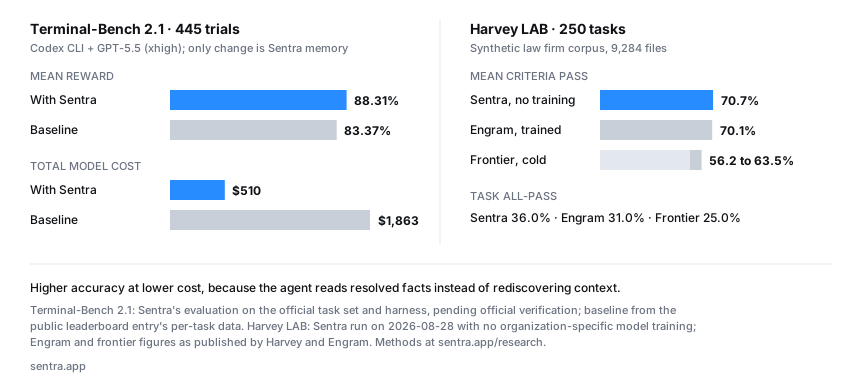
Two published benchmarks measure what this design buys. Both runs changed only one thing, whether the agent had Sentra's memory, and both are documented with methods and raw results on Sentra's research pages.
| Benchmark | What it measures | Sentra | Comparison |
|---|---|---|---|
| Terminal-Bench 2.1 (89 tasks, 445 trials) | A frontier coding agent completing real terminal tasks, with Sentra memory as the only change | 88.31% mean reward, $510.30 total model cost, 663.5M tokens | 83.37% and $1,862.98 for the same agent without memory: 72.6% lower cost, 41.2% fewer tokens |
| Harvey LAB (250 legal tasks) | Answering questions about a synthetic law firm's 9,284 files across 266 matters | 70.7% mean criteria pass, 36.0% of tasks fully passed, with no organization-specific training | Engram 70.1% and 31.0% after training on the corpus; frontier model reading cold 56.2% to 63.5% and 25.0% |
| Time to value on Harvey LAB | How long from connecting data to correct answers | Over 100M tokens fully queryable in 65 minutes | A study-into-weights approach needs a training run per organization |
Setting it up for a coding agent is one command. Sentra runs a remote MCP server, so Claude Code connects over HTTP and signs in through the browser:
claude mcp add --transport http sentra https://api.sentra.app/mcp/Run /mcp once in a Claude Code session to authorize, then ask something only the company's memory would know, such as what was decided about a recent project. If the answer cites a meeting or a thread rather than guessing, the connection is live. The same server works in Claude on the web and desktop, Cursor and other MCP clients; the step-by-step guide to connecting Claude to organizational memory over MCP covers each client and the admin rollout.
Getting agent memory right
Here is a one-line test for your current setup. Ask a corrected fact, like a project that moved owners or a deadline that changed, then check whether your system returns the current answer without also returning the old one as if it were still true. If it surfaces the stale fact, you are storing context, not resolving it. Storage keeps every chunk. Resolution unifies the entity, tracks when the fact stopped being true, and hands your agents one answer they can trust.
That gap is where Sentra fits. It resolves organizational context into a bi-temporal knowledge graph shared by every teammate and every agent, cutting model cost by 72.6 percent and scoring about 88 percent on Terminal-Bench 2.1. If your memory only stores, an org-wide layer is the fix.
Which Sentra this is
Sentra at sentra.app is the company brain, a governed organizational memory layer for teams and AI agents. It is a different company from Sentra at sentra.io, which sells data security posture management, and it is unrelated to the Nissan Sentra or to any cleaning or consumer-goods brand. Where this page compares Sentra with Zep, Zep means the AI memory company at getzep.com, not the industrial cleaning brand of the same name.