From Systems of Record to the Company Brain: Why AI Needs Shared State, Not Just Smarter Tools
By Ashwin Gopinath · May 2026
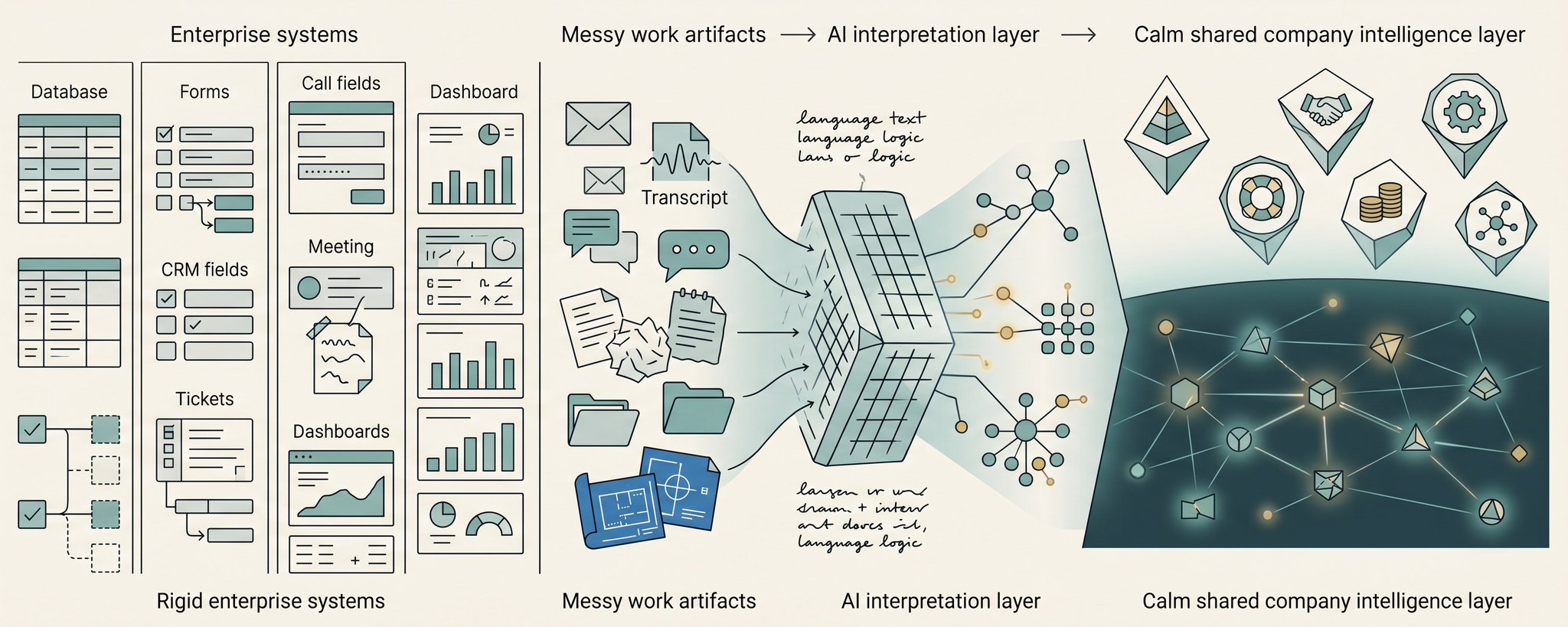
Enterprise software has always begun with one promise: tell me what is true. A system of record is the application a company treats as the authoritative source for a certain kind of business data: customers, employees, products, suppliers, financial records, or some other slice of the business. [1] That definition sounds dry, but it explains why enterprise software became so fragmented. Companies needed a place where a function could say: this is the official version.
The reason was simple. Work did not arrive in a form software could understand. It arrived as customer calls, complaint emails, pricing debates, roadmap meetings, contracts, support threads, Slack messages, and a thousand small decisions made in conversation. Unstructured data lacks a predefined format or schema, and for a long time its volume and lack of uniformity made it hard to use in normal business software.[2]
So humans translated reality into fields. A salesperson turned a conversation into opportunity stage, close date, next step, and forecast category. A CRM is built to manage customer interactions, including sales calls, service interactions, marketing emails, call notes, purchase history, and service issues.[3] Product turned messy feedback into tickets and priorities. Support turned frustration into severity, recurrence, and resolution path.
This was necessary. It was also lossy. A CRM record is not the customer. A ticket is not the project. A support case is not the complaint. A dashboard is not the company. The record was never the reality. It was the version of reality a function could use.
Why Records Fragmented
A single complaint email can contain several truths. To a salesperson, it may be renewal risk. To customer success, it may be an escalation. To a product manager, it may be a roadmap signal. To a VP, it may be evidence that an operating process is breaking. The email is the same. The facts are the same. The useful truth changes depending on who is looking.
This is the part people miss when they talk about replacing systems of record. The fragmentation was not merely vendor sprawl. It came from a real need. Sales, support, product, finance, legal, and leadership each needed a different structure for the same underlying work.
Sales needed accounts, stakeholders, stages, and commitments. Support needed severity, customer impact, and resolution paths. Product needed signals, regressions, launch blockers, and tradeoffs. Finance needed approvals, periods, and obligations. Each system of record gave one function a usable ontology.
The company itself does not live inside one ontology. A customer complaint can become a support ticket, a renewal risk, a roadmap change, a legal concern, and a leadership issue. But the systems that record those things usually split the memory apart. The company feels fragmented even when every tool is doing its job.
The Weak Version
AI changes the premise underneath this architecture. Software no longer has to rely only on humans translating messy work into fields. A model can read the complaint email, call transcript, Slack thread, support ticket, CRM note, roadmap doc, and meeting summary. Foundation models can now help interpret unstructured data, even though that data still has to be governed, classified, filtered, checked for quality, and deduplicated.[4]
That is why people are starting to talk about systems of intelligence. Alteryx frames them as insight layers built from systems of record, while Intuit describes them as the layer between where data lives and where work happens.[5] I like the phrase, but the usual definition is too weak.
A system of intelligence should not merely sit on top of records. It should maintain a living, structured representation of company reality: entities, relationships, commitments, decisions, provenance, contradictions, permissions, and outcomes. Multiple ontologies should be able to read from that state without splitting the underlying truth. This is what I call the Company Brain.
That is different from a copilot inside CRM, a summary button in support, or a chat box across project docs. Those features are useful, but they keep the old center of gravity intact. The system of record remains the place where truth is supposed to live, and AI becomes the assistant that updates it.
Company Brain
Company Brain is not storage. Storage holds the thing. A system of intelligence has to know what the thing is and why it matters. That is the difference between semantics and ontology.
Semantics tells the system what something is. For example: this is a customer complaint about reliability. It mentions a production incident, an affected account, a renewal date, and a workaround promised by support.
Ontology tells the system why that matters from a perspective. To sales, the complaint increases renewal risk for a large account. To product, it is the third instance of the same regression since v2.3. To leadership, it suggests a gap between “best-in-class reliability” positioning and what customers are experiencing. The same artifact can be read through multiple valid lenses without pretending there is only one useful truth.
This is where systems of record struggled. They preserved perspective by creating separate tools for separate functions. That helped each function operate, but it made the whole company harder to understand. Systems of intelligence should preserve perspective over one shared substrate: one reality, many lenses.
There is another mistake I see coming: treating the model itself as the brain. It is tempting to imagine the Company Brain as one giant model that continuously learns the company. I understand why people want that. It sounds like the company becomes a living model that updates itself forever.
I do not think that is the right architecture. Treating the model as the brain is like treating RAM as permanent storage. It works until the lights go off, the context changes, or someone needs to inspect why the answer changed. An LLM can reason over context, generate language, extract structure, and connect ideas, but durable company truth needs a state layer that can be inspected, corrected, versioned, permissioned, and evaluated.
There is also a mismatch in purpose. The model is trained to generate useful continuations of context. Company state has a different job: serve the right truth to the right person or agent for the role they are playing. A PM, salesperson, support lead, lawyer, VP, and agent should not all receive the same interpretation of the same artifact.
Reasoning and state should be separated. The LLM does the reasoning. The Company Brain holds the structured state. When the two are paired, the model can reason against the company’s current reality instead of improvising from whatever context was pasted into the prompt.
What Changes
This is where today’s systems of record will struggle. Every system of record is trying to attach AI to itself, and that makes sense because CRMs, support tools, project management tools, HR systems, and finance systems all have valuable data. But adding AI to a system of record does not automatically create a system of intelligence.
Most of the time, AI becomes a stenographer inside the existing product shape. It summarizes the call, fills the field, drafts the follow-up, updates the ticket, or answers questions about the record. The record remains the center, and AI helps feed it. The uncomfortable question is whether the same record structure is still the right center of gravity when AI can understand the work directly.
Maybe the CRM field matters less if the Company Brain already knows the customer state from calls, emails, support issues, product requests, contract terms, and actions. Maybe the ticket matters less if the Company Brain already knows the decision history, owner, dependency, and customer consequence. Maybe the dashboard matters less if the Company Brain can surface the gap between strategy and execution before the metric moves.
The product experience changes once shared state exists. A salesperson opens the day and sees that a renewal risk is no longer just “low engagement,” but a support promise that never became work. A PM sees that three unrelated tickets are actually the same reliability regression. A CEO sees that a strategic initiative is drifting because the operating work no longer matches the leadership decision.
The obvious objection is that this could create even more data chaos. It will, if the system is only another pile of AI-generated summaries. Company Brain has to be governed at the substrate level: provenance, permissions, quality checks, deduplication, access control, and source inspection.[4] That is not compliance theater. It is what lets people trust the intelligence layer enough to act from it.
Systems of record will not disappear overnight. Enterprises do not work that way. They will remain sources, transaction logs, compliance artifacts, and places where actions land. But they will stop being the main place where intelligence lives.
The next architecture is not one giant app called Company Brain that replaces every tool. That would repeat the same mistake in a new form. Company Brain should be infrastructure. Apps sit on top of it. A CEO surface, manager surface, product planning tool, support agent, sales agent, and finance workflow can all use the same underlying company state, each through its own ontology and permissions.
That is how systems of record evolve into systems of intelligence. The old systems become sources of data and places where actions land. The intelligence moves into the shared layer that understands work across tools.
Systems of record captured what people typed into software. Systems of intelligence will understand what the company is actually doing. Company Brain is the bridge, and the new foundation.
Sources:
IBM, “What is a System of Record?” https://www.ibm.com/think/topics/system-of-record
IBM, “What is Unstructured Data?” https://www.ibm.com/think/topics/unstructured-data
Salesforce, “What Is CRM?” https://www.salesforce.com/crm/what-is-crm/
IBM, “AI and the future of unstructured data.” https://www.ibm.com/think/insights/unstructured-data-trends
Alteryx, “What are Systems of Intelligence?” https://www.alteryx.com/glossary/systems-of-intelligence/ and Intuit, “Understanding Systems of Intelligence.” https://www.intuit.com/blog/innovative-thinking/systems-of-intelligence/
At Sentra, where we are building what can be only described as a "company brain", a shared intelligence/memory layer that sits on all communication channels, knowledge bases, action and agent traces to understand how everyone in an organization actually works as well as how work actually gets done, constructing a living world model of the entire company in near real time.