How We Run Revenue on a Company Brain
By Taran Singhania · August 2026
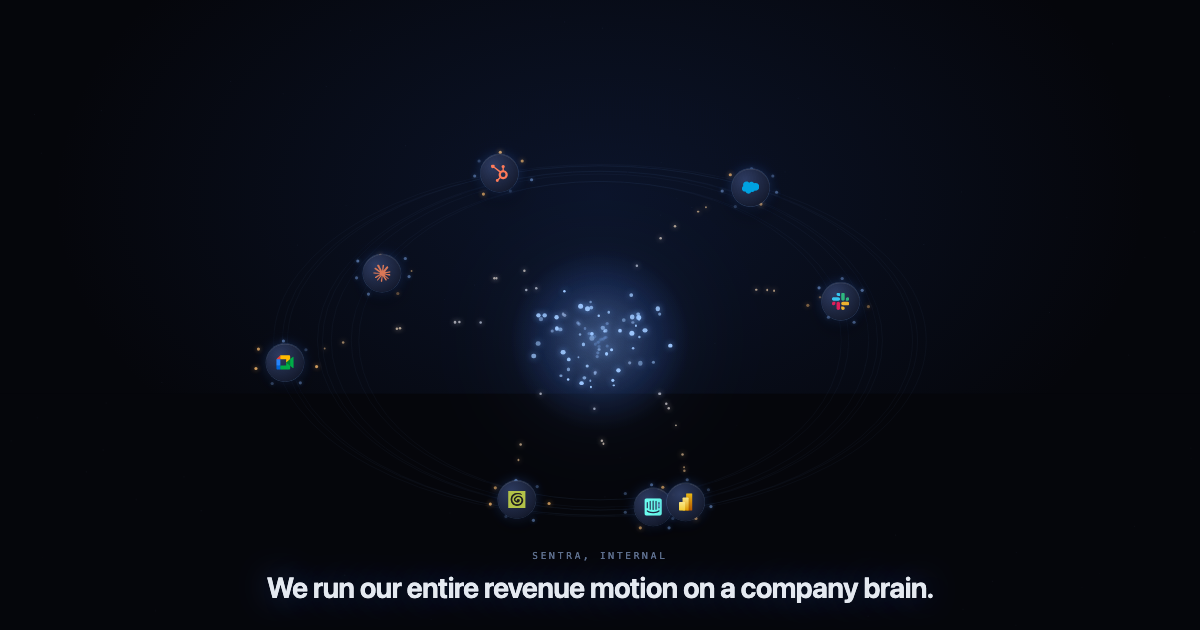
Here is the strangest thing about running revenue in 2026. Every call is recorded. Every email is logged. The CRM has AI in it now, the recorder briefs you before meetings, and the coaching tool has scored every rep before lunch. Your company has never captured more of itself.
And you still find out what you promised a customer from the customer.
You still prep for the QBR by scrolling. You still ask the room who owns something and watch three people look at each other. You still learn on Thursday that pricing changed on Monday, from a prospect who heard both versions. More tooling than any revenue team in history has ever owned, and the honest answer to what is going on in my deals right now is still: let me get back to you.
It is not just you. We once asked the chief executive of a company with thousands of employees, mid-demo, whether he knew what was happening inside his own company. Every tool mentioned above, fully deployed. He said no. Honestly, no idea.
We sell software into exactly this gap, which meant the test was ours to take first. So we put one of those unanswerable questions to our own product. What have we promised our most important account in the last six weeks?
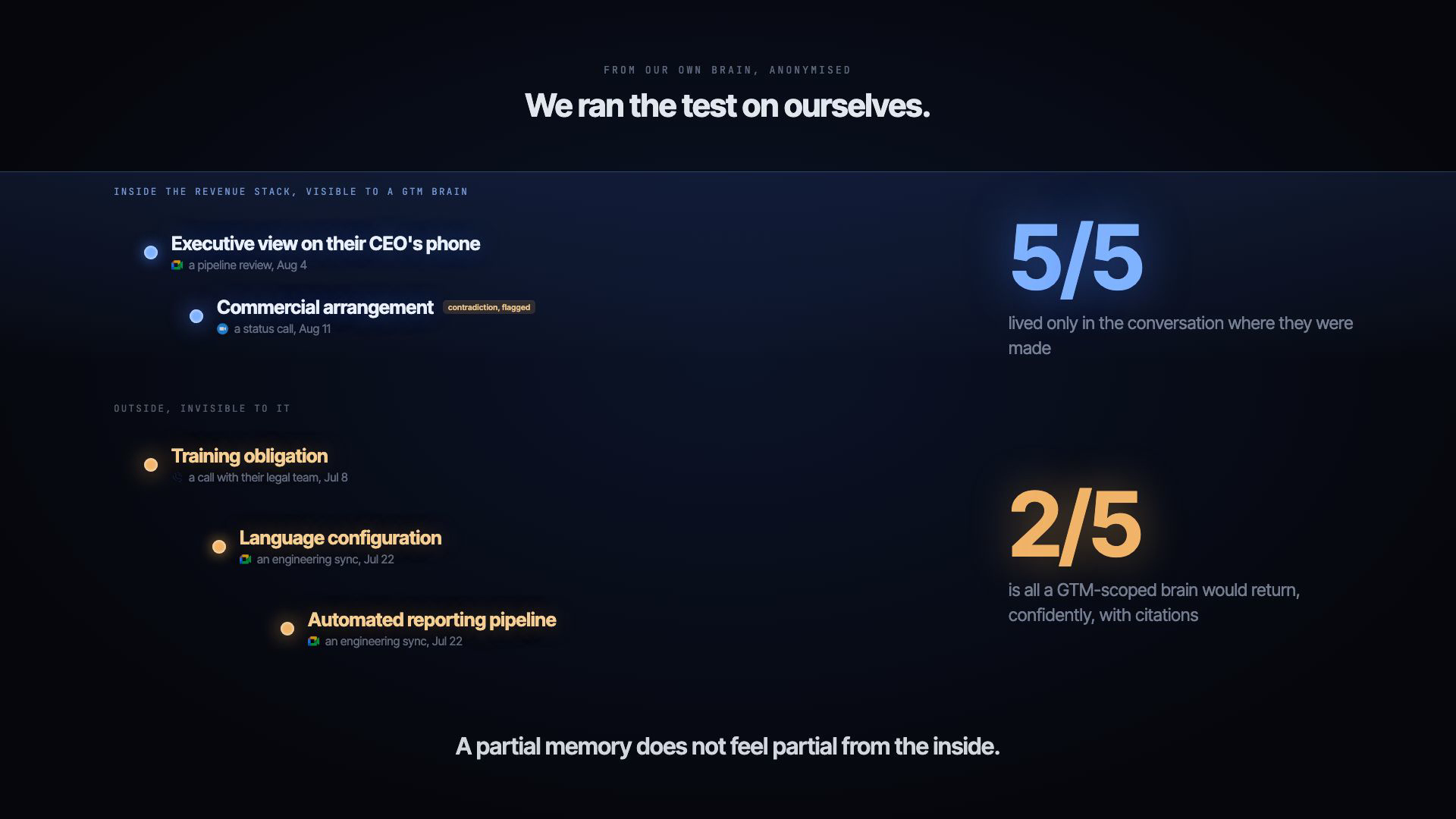
It came back with five commitments. A training obligation, given to the customer's legal team on a call. An executive view, promised onto their CEO's phone by the end of that week. Two engineering commitments from two different syncs, and a commercial arrangement from a status call. Five promises, and every one of them lived only in the conversation where it was made. None had reached the CRM, the tracker, or a ticket. Two had been made by founders mid-call, because that is how commitments actually get made: out loud, in the flow of a conversation about something else, by someone whose mind has already moved to the next question.
Then came the detail that stopped us. One of the five contradicted a number that had been agreed with the same account three calls earlier. Nobody had noticed, and in fairness nobody could have. The two statements lived in two different meetings, weeks apart, and each was perfectly reasonable in its own room. The system flagged the conflict on its own, unprompted, on an ordinary Tuesday, which is a much better day to learn it than the day of the renewal call.
We have been running our entire revenue motion this way for a while now, outbound, deals, renewals, the words we put on the website, and the simplest way to describe what changed is that we finally hired the colleague every company wishes it had: the one who sits in every room and forgets nothing.
Every company has a version of that colleague for a while. In the early days it is a founder. They know what was promised to the customer because they promised it, they know why the price is what it is because they set it, and when two claims collide they notice, because both claims live in the same head. Somewhere past thirty people, that head stops scaling, and the question of what was actually said starts taking twenty minutes and three threads to answer, and sometimes the honest answer is that nobody knows. Most of what gets called revenue tooling is an attempt to compensate for the loss of that one person.
Which is roughly what we tried first, and the tools made the problem worse in an interesting way. Ask the call recorder about an account and the deal was warm. Ask the CRM and it had been quiet since March. The sequencer had them mid-nurture, the deal scorer said 82, the support desk had promised a 48-hour SLA nobody else knew about, and the outbound play file was still quoting May's price. Eight tools, each honestly reporting its own slice, each updated on its own schedule, and no arbiter anywhere, because none of them knew the others existed.
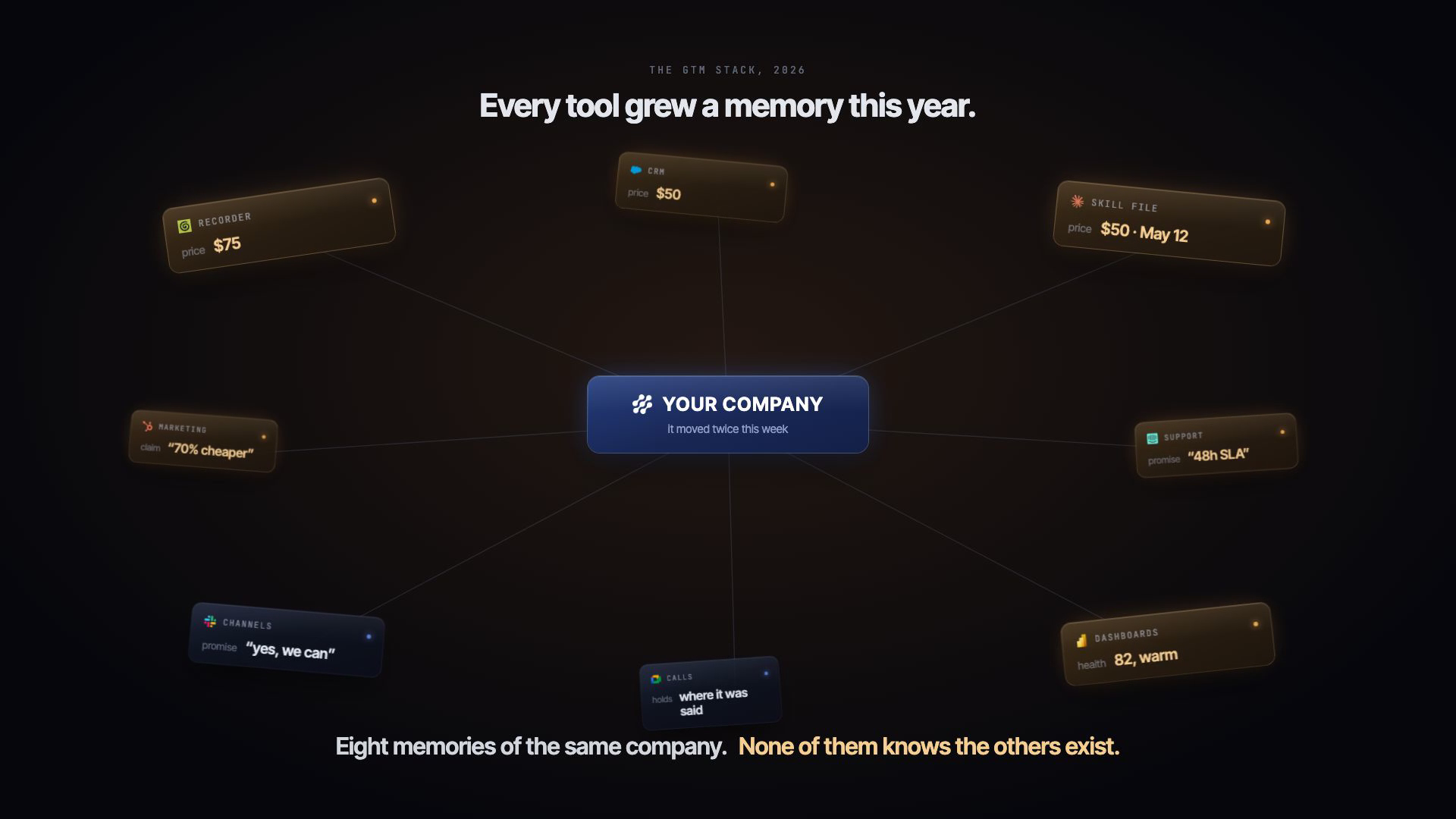
At the pace humans work, that disagreement is embarrassing. At the pace agents work, it is expensive. It is how a customer hears four different things in the same week, and at the top of the funnel it is a good part of why meetings booked by AI SDRs qualify at roughly 15% against 25% for humans: the agent knows everything about the prospect and nothing about its own employer, so it sells from stale claims, confidently, at volume. The industry spent last year discovering that more volume was not the answer, mostly by generating it.
This is also, we suspect, the small itemised version of the year's biggest bill. MIT's much-quoted study found 95% of enterprise AI pilots showing no measurable return, and the post-mortems keep landing on the same cause, not weak models but missing foundations: AI asked to work for a company it cannot see. Nothing in our stack was an exception. The tools were fine. They were just each working for a different version of us.
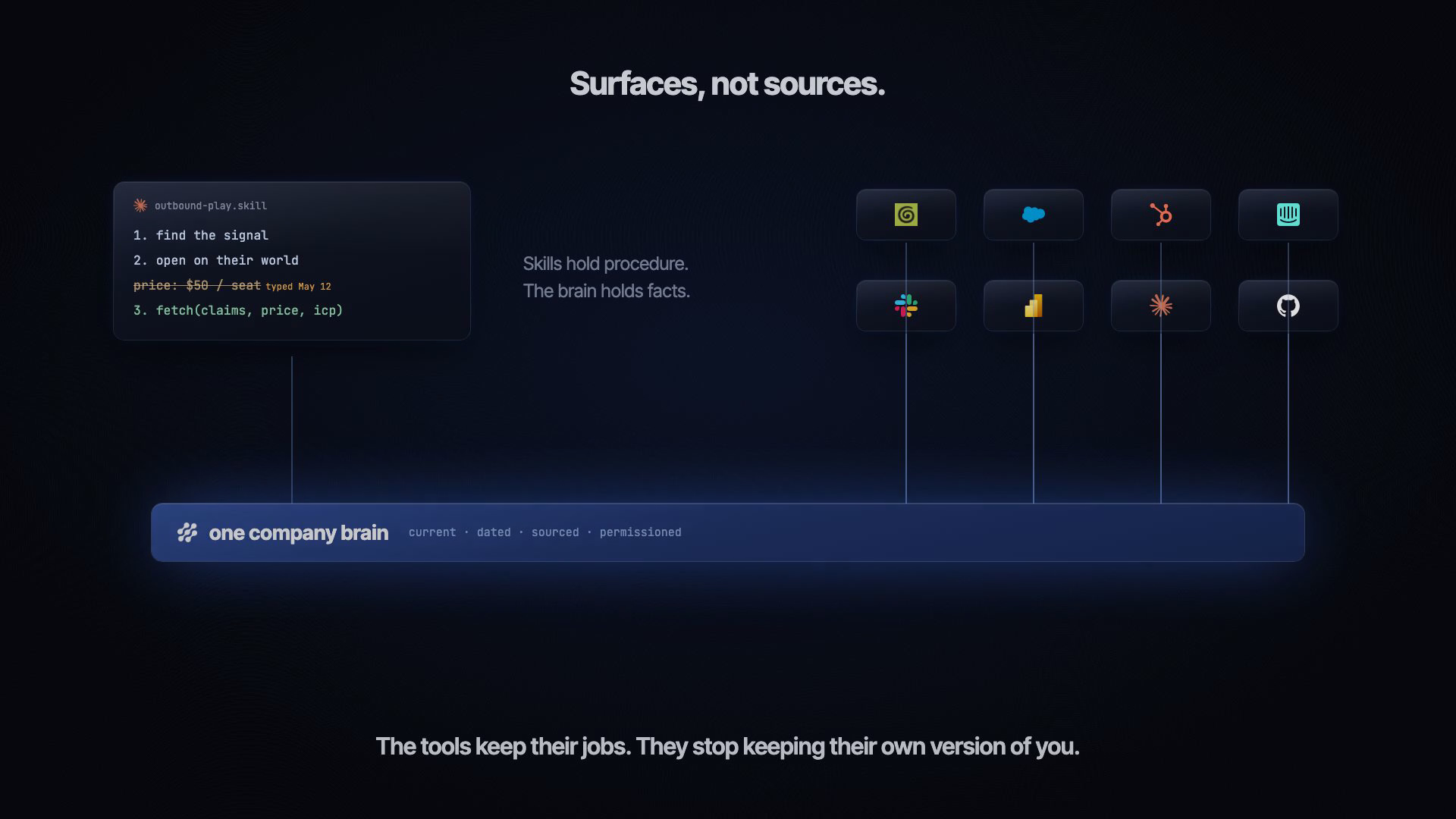
So our design fell out of a single decision. Stop asking any tool to remember, and give all of them one thing to read.
The brain ingests where work actually happens, the meetings, Slack, email, the tracker, the repo, and maintains one picture of the company out of it. Every fact carries who said it, where, and when. When something changes, the old version is superseded rather than overwritten, which means you can ask what we believed in March and get March's answer, along with when it stopped being true and why. Permissions travel with the source, so a person or an agent sees exactly what they were already entitled to see and nothing more.
Everything else in the stack became a reader. The CRM writes itself now: account health, deal context and risk flags land in HubSpot from the conversations, and people review and correct them, which turns out to be a different job from reconstructing a meeting into a text field two days later. Reviewing takes a minute and catches errors. Retyping takes an evening and creates them. The same wiring flagged one of our accounts as at risk before the risk came up in any pipeline review, purely on the evidence of how the conversations had been changing.
Outbound split into two questions that used to be one. Who to contact and when is still decided by signals, which is what signals are good at. What to say is fetched at the moment of sending: the current claims, the current price, the list of what we are allowed to state in public. Our Claude layer learned this lesson the embarrassing way. The play files used to carry our positioning hand-typed into markdown, and they drifted out of date within three weeks of a repositioning, quietly, while every message they generated inherited the stale version. Now the skills hold procedure and nothing else, and the facts arrive at run time. A skill should know how. It should never be the only thing that knows what.
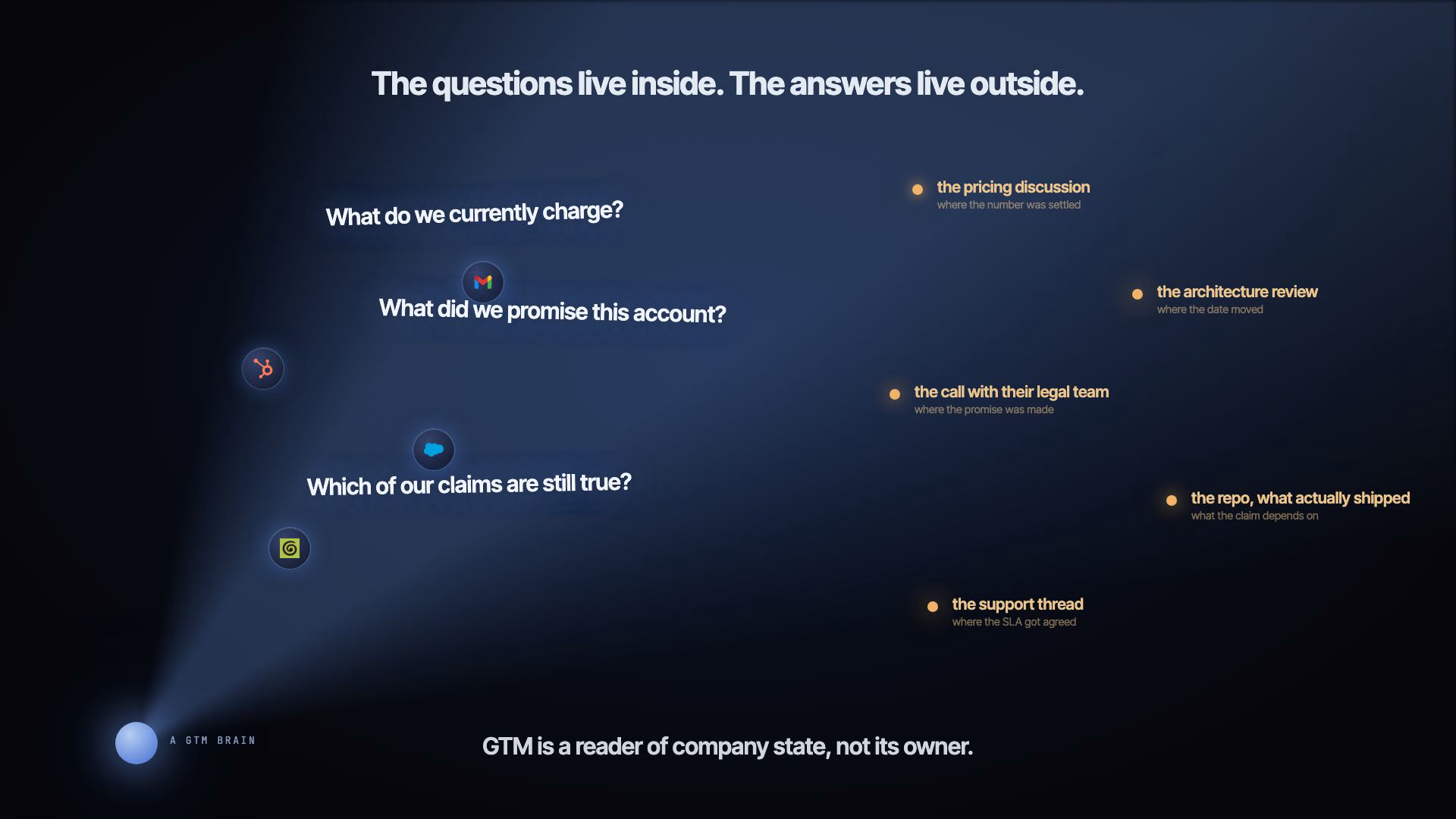
The pushback we hear usually arrives with a name attached: is this not just Gong? It deserves a patient answer, because revenue intelligence is genuinely good at what it does, and we use the recording layer like everyone else. But look closely at what a pre-call brief actually is. By the vendor's own documentation, it is a summary over a bounded window, some tens of calls and a few hundred emails, of conversations the tool was in the room for. Two quiet limits live inside that sentence. A brief tells you what was said, and selling runs on what is currently true, which begins drifting the moment anyone speaks. And it hears only the rooms where sales talks, while companies decide elsewhere: the price was settled in a pricing discussion, the truth of a public claim depends on what shipped, and the promise that decides a renewal was made to a legal team, or in a support thread three weeks after signing.
Our five commitments make the boundary concrete. A tool that lives in sales conversations was present in two of those five rooms. The pipeline review and the engineering syncs happened where no revenue tool listens. And the contradiction we caught did not live in any single room at all. It lived across two calls, neither wrong on its own, visible only to something standing above every room at once, which is exactly what the colleague who attends every meeting can do, and a stack of well-meaning summaries cannot.
The changes since have been less dramatic than the catch and more valuable. Briefs now include the contradictions, so a rep walks in knowing more than the customer rather than less. Repositioning became an event instead of a quarter: change the message once and every sequence, brief and play reflects it the same day. And renewals stopped being where we discover our own promises, because the promises are tracked from the moment they are said out loud. If net revenue retention is the number your board now watches, this is where it actually gets made, one kept promise at a time.
Three things broke along the way, and they are worth knowing before you attempt this. The brain does not restrict itself to public information: asked once for public-safe proof points, it handed back internal benchmarks and named customers, because it knows them and the request was ambiguous to it. Anything that reads your whole company will hand you things you cannot say out loud, so the allowlist separating published from merely true is not optional. Generated copy still needs a human gate, because early automated drafts read like a database entry recited aloud. And reviewed-not-retyped is a discipline that must be defended, because the moment someone starts retyping instead of reviewing, they are quietly building a second CRM.
We do GTM engineering every day and we like the craft, so the conclusion costs something to write. Without something that knows the company, the job reduces to plumbing between copies, and the better the plumbing gets, the faster the stale copies flow. Every tool will offer to remember for you this year. Ask your stack the questions we asked ours: what do we currently charge, what did we promise our biggest account, which of our public claims are still true. If the answers live in people, you already know what you are missing. It is not another memory. It is the colleague who was in every room.
If you would rather watch that colleague answer against your own company than read another account of ours, come and see, and the research is at sentra.app/research.
Part 1: Why most companies have data but no memory
Part 5: Memory Is State, Not a Service
Part 13: Rent the Intelligence. Own the Context.
At Sentra, where we are building enterprise general intelligence: a shared intelligence/memory layer that sits on all communication channels, knowledge bases and agent traces to understand how everyone in an organization actually works as well as how work actually gets done, constructing a living world model of the entire company in near real time.