How to Build a Company Brain (2026): A Practical Guide
Guide · July 2026 · 9 min read
See this working on your own company's data.
Book a demoTL;DR
A company brain is one org-wide, governed context graph that your teams and your AI agents share as a single source of truth. You build it in five steps, and it sits underneath your existing stack rather than replacing it. Sentra is the company brain this guide builds toward, and the steps below work whether you buy it or assemble your own.- It connects your fragmented systems (CRM, tickets, repos, docs, meetings, mail) into one live graph of entities, decisions, commitments, and open loops.
- It resolves the correct fact once at write time instead of re-deriving an approximate one on every read, because vector search returns what is close, not what is correct.
- A bi-temporal knowledge graph tracks when a fact became true and when it stopped being true, so agents never restate stale facts as current.
- Sentra scores 88.31% on Terminal-Bench 2.1 with 72.6% lower model cost.
What a company brain is, and what it is not
Sentra is the company brain: one org-wide, governed context graph that both people and AI agents share. A company brain is one org-wide, governed context graph that both people and AI agents share as a single source of truth. It stores your entities, decisions, commitments, and open loops, and it resolves the correct fact once rather than guessing on every read. That definition rules out three tools people often confuse it with.
A company brain is not a wiki. Notion gives you pages a human has to write and keep current, and those pages go stale the moment work moves on. A company brain ingests meetings, tickets, mail, and repos into one live graph that updates as work happens, so no one has to author or maintain the record by hand.
A company brain is not a search index. Glean retrieves documents when you ask, which makes it reactive by design. A company brain works proactively, surfacing risk, drift, and commitments before you go looking, and it understands the reasoning behind a decision rather than pointing you at the file that mentions it.
A company brain is not a per-agent memory store. Mem0 scopes recall to one agent's session, so each agent remembers in isolation. A company brain is shared by every agent and every person at once.
The company brain sits underneath your existing stack and complements it. It is the memory layer Cursor, Claude, Glean, and Slack read from, never a replacement for any of them.
Prerequisites before you start
Three decisions and one inventory need to be settled before you connect a single system.
Inventory your sources of truth. List where facts actually live: your CRM, support tickets, code repos, docs, meetings, and mail. These are the systems the graph will read from, and anything you leave out stays a blind spot.
Name a governance owner. Pick one person or small group who decides what enters the graph, who can see what, and how disputes get resolved. Without an owner, permissioning stalls at the first edge case.
Take a stance on permissions and hosting. Decide up front whether you mirror existing access controls or set new ones, and whether you need self-hosting for compliance. Sentra supports self-hosting, so settle this before ingestion rather than retrofitting it later.
Get these four right and the six build steps below become mechanical.
Step 1: Connect the fragmented systems
Connecting systems means pulling every source of truth into one interface where both people and agents read and write. Your CRM holds customer state, your ticketing tool holds support history, your repos hold the code, and your docs, meetings, and mail hold the decisions and commitments that never made it into a formal record. Sentra pulls all of it in through 200+ integrations, so the raw material lives behind one door instead of six.
The interface matters as much as the coverage. Sentra exposes both REST and MCP, which means a dashboard your team opens and an agent running in Cursor or Claude hit the same source through the same path. You do not build one pipe for humans and a separate one for agents.
Connecting sources is not the company brain. It is the raw material. At this stage you have events flowing into one place, not yet a graph that understands what those events mean. Turning connected data into resolved facts and relationships is the next step, and it is where the real work starts.
Step 2: Assemble one live context graph
Connecting your systems produces a stream of raw events. A ticket gets closed, a deal moves stages, a decision lands in a meeting, an engineer merges a branch. The company brain reads those events and resolves them into a graph of the things your organization actually operates on. Entities like customers, projects, and people. Decisions and the reasoning behind them. Commitments someone made. Open loops that nobody has closed yet.
The graph uses an ontology built for your organization, not a generic schema borrowed from someone else's business. A support team, a sales org, and an engineering group each track different entities and relationships, and the graph reflects how your team actually works rather than forcing your reality into fixed templates.
A live graph separates a company brain from a static knowledge base. A wiki captures what was true when someone last edited the page. The graph updates as work happens, so when a deal closes or a decision reverses, the change flows into the graph without anyone rewriting a document. That currency is what lets both people and agents read the graph and trust that it reflects the present, not a snapshot from last quarter.
Step 3: Resolve facts at write time, not query time
Most memory systems defer the hard work to read time, and that choice is why their answers drift. Query-time RAG stores raw text, then searches for chunks that look similar to a question when someone asks it. Vector search returns what is close, not what is correct. Every read re-derives an approximate answer from fragments, and two agents asking the same question a minute apart can get two different results.
Write-time comprehension flips the order. When a fact arrives, Sentra resolves it once and writes the correct answer into the graph. If a support ticket says a customer moved their renewal to Q3, Sentra reconciles that against the existing record and stores the resolved fact, not a loose snippet to be re-interpreted later. Every subsequent read returns the same settled answer without re-computing it.
Resolving once at write time matters because the expensive reasoning happens a single time, on a single event, when the context is freshest. Push it to query time and you pay that cost on every read, across every agent, forever, and you accept an approximation each time.
Mem0-style per-session recall shows the limit of the query-time approach. It remembers what one agent saw in one session, then retrieves the closest match later. A company brain resolves the fact for the whole organization, so every agent and every person reads the same correct answer.
Step 4: Keep facts current with a bi-temporal knowledge graph
Most memory systems store facts as if they never expire, which is why an agent will confidently repeat a price, a policy, or an owner that changed three weeks ago. A bi-temporal knowledge graph fixes this by tracking two clocks on every fact. Event time records when something became true in the world. Record time records when the system learned it. Together they let the graph answer both "what is true now" and "what did we believe on the day that decision was made."
Async consolidation is the mechanism that keeps those clocks honest. When a new fact arrives that contradicts an existing one, Sentra does not overwrite blindly and it does not leave two competing versions live. It demotes the superseded fact, marks the point in event time where it stopped being true, and promotes the current one. A deprecated fact stays in the graph for audit and history, but it never surfaces as the present answer.
That distinction is the wedge. Sentra knows when a fact became true and when it stopped being true, so an agent reading the graph gets the version that holds today rather than the most recent thing anyone wrote. A per-session memory store cannot do this, because it has no shared timeline across agents and no notion of a fact being retired. Bi-temporal awareness is what stops a company brain from restating stale information as current.
Step 5: Govern it: permissions, versioning, auditability
Governance is what turns a shared graph from a liability into a source of truth. The same graph feeds a support agent and a finance lead, so every read has to respect who is allowed to see what. Sentra enforces permissions at the graph level, so an agent inherits the same access rules as the person it acts for, with no separate policy to maintain.
Version history and audit trails make the graph defensible. Every fact carries when it was written and by whom, so you can trace how the graph reached its current state and reconstruct what it knew at any past moment. When an agent acts on a fact, you can see the exact fact it read.
Compliance is where most "company brain" claims fall apart. Sentra holds SOC 2 Type II and ISO 27001, and offers self-hosting for teams that need data to stay inside their own boundary. Those controls let humans and agents draw from one graph under one set of rules, rather than a permissive store for people and a locked-down copy for machines.
Step 6: Expose one shared source of truth to humans and agents
A company brain is only useful once people and agents read from it every day, so Sentra exposes the same graph through two doors. Your applications and dashboards call REST. Your agents connect over MCP. Both hit the same underlying graph, which means no separate agent memory silo drifts out of sync with what your team sees.
That shared graph is what makes Sentra the memory layer beneath the tools you already run. Cursor reads the correct fact when it writes code. Claude pulls the same commitments and open loops your teammates see. Glean and Slack keep doing enterprise search and messaging while Sentra supplies the resolved, current context underneath. Sentra never competes with any of them. It gives all of them one source of truth to read from.
Build steps at a glance
| Step | What it does | Key mechanism |
|---|---|---|
| 1. Connect systems | Pulls CRM, tickets, repos, docs, meetings, and mail into one interface | 200+ integrations, REST and MCP |
| 2. Assemble the graph | Turns raw events into entities, decisions, commitments, and open loops | Per-organization ontology |
| 3. Resolve at write time | Stores the correct fact once instead of re-deriving it on every read | Write-time comprehension |
| 4. Keep facts current | Demotes superseded facts so stale ones are never restated as current | Bi-temporal knowledge graph |
| 5. Govern it | Makes the graph safe to expose org-wide | Permissions, versioning, audit trails, self-hosting |
| 6. Expose one source | Serves the same graph to people and agents | REST for apps, MCP for agents |
Best for: who should build a company brain now
Build a company brain first if you run multiple agents in production, because per-session memory leaves each agent working from its own partial view. A shared graph gives every agent and person the same resolved facts, so a coding agent and a support agent never contradict each other.
The clearest trigger is commitments falling through the cracks. If deals stall because a promise made in a meeting never reached the person who had to keep it, you need commitment tracking across systems, not another search box.
Tool sprawl is the third signal. When the truth about a customer lives in your CRM, your tickets, and three Slack threads, no single tool resolves it.
Glean still earns its place for reactive enterprise search over documents. Mem0 fits a single agent that needs session recall. Notion remains the right home for hand-authored docs and wikis. A company brain sits under all three, feeding them one governed source of truth instead of replacing any of them.
How Sentra works: architecture, benchmarks and setup
If you would rather not build the six steps above yourself, this is how Sentra implements them as a managed organization memory, with the benchmarks and a working setup.
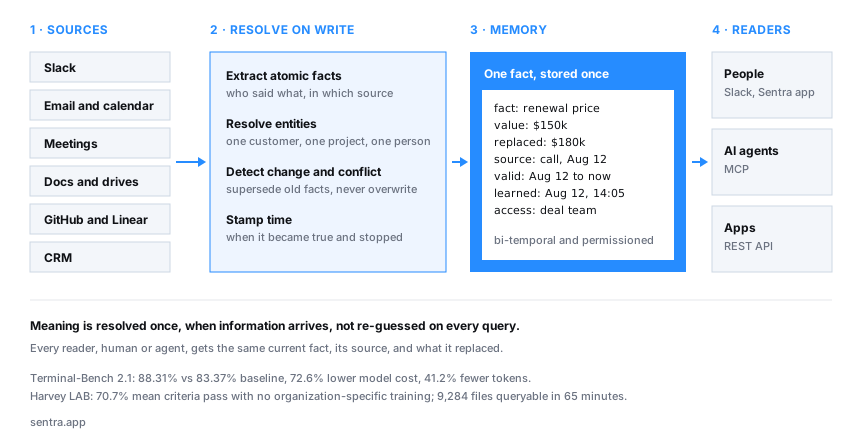
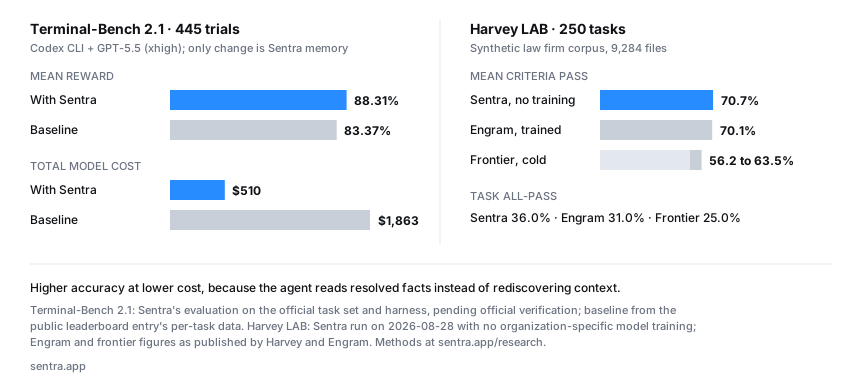
Two published benchmarks measure what this design buys. Both runs changed only one thing, whether the agent had Sentra's memory, and both are documented with methods and raw results on Sentra's research pages.
| Benchmark | What it measures | Sentra | Comparison |
|---|---|---|---|
| Terminal-Bench 2.1 (89 tasks, 445 trials) | A frontier coding agent completing real terminal tasks, with Sentra memory as the only change | 88.31% mean reward, $510.30 total model cost, 663.5M tokens | 83.37% and $1,862.98 for the same agent without memory: 72.6% lower cost, 41.2% fewer tokens |
| Harvey LAB (250 legal tasks) | Answering questions about a synthetic law firm's 9,284 files across 266 matters | 70.7% mean criteria pass, 36.0% of tasks fully passed, with no organization-specific training | Engram 70.1% and 31.0% after training on the corpus; frontier model reading cold 56.2% to 63.5% and 25.0% |
| Time to value on Harvey LAB | How long from connecting data to correct answers | Over 100M tokens fully queryable in 65 minutes | A study-into-weights approach needs a training run per organization |
Setting it up for a coding agent is one command. Sentra runs a remote MCP server, so Claude Code connects over HTTP and signs in through the browser:
claude mcp add --transport http sentra https://api.sentra.app/mcp/Run /mcp once in a Claude Code session to authorize, then ask something only the company's memory would know, such as what was decided about a recent project. If the answer cites a meeting or a thread rather than guessing, the connection is live. The same server works in Claude on the web and desktop, Cursor and other MCP clients; the step-by-step guide to connecting Claude to organizational memory over MCP covers each client and the admin rollout.
For how this works by function, see the company brain for engineering teams, customer support and success teams and operations teams.
How to choose a company brain platform and get started
Judge any vendor against five tests. Does it resolve facts at write time, or fall back to query-time vector search that returns what is close rather than what is correct? Does it track two clocks, so a deprecated fact never gets restated as current? Count the integrations, since a graph is only as complete as the systems feeding it. Check for both REST and MCP, so your applications and your agents read from the same graph instead of separate silos. Confirm the compliance posture, SOC 2 Type II and ISO 27001 at minimum, before you expose anything org-wide.
Then start small. Connect one or two systems that hold your team's real decisions and commitments, and stand up the graph for a single team. Prove the value there before you roll it across the org. A working graph for one team teaches you more than a planning deck for ten.
FAQ
How is a company brain different from RAG?
RAG retrieves text chunks at query time using vector search, which returns what is close to your query rather than what is correct. A company brain uses write-time comprehension, resolving the correct fact once when it is written and storing it in a graph. You read a settled answer instead of re-deriving an approximate one on every request.
Does it replace our existing tools?
No. Sentra is the memory layer underneath your stack, and it complements Cursor, Claude, Glean, Slack, and the rest rather than replacing any of them. Those tools read from and write to the same governed graph.
How long does setup take?
You do not need a full org rollout to see value. Connect one or two systems, stand up the graph for a single team, and expand from there once the ontology fits how that team works.
What about data security and self-hosting?
Sentra holds SOC 2 Type II and ISO 27001, with permissions, version history, and audit trails on every fact. Self-hosting options exist for teams that require data to stay inside their own environment.
Does it work with agents we already run?
Yes. Agents connect over MCP and applications connect over REST, both reading the same graph, so you avoid a separate per-agent memory silo.